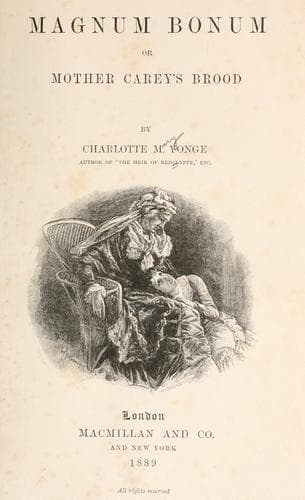
Magnum Bonum; Or, Mother Carey's BroodYonge, Charlotte M. (Charlotte Mary)
General
Magnum Bonum; Or, Mother Carey's Brood
Yonge, Charlotte M. (Charlotte Mary)
Domestic fiction; England -- Social life and customs -- 19th century -- Fiction; Religious fiction
“You ought to have seen; but you never think of anything but your own
chatter.”
“It is a very inconvenient loss,” said Mrs. Evelyn, kindly. “Have you
sent to the station?”
“I shall, as soon as I am satisfied that it is not here. I can send
out for the things I want for use; but there are books and papers of
importance, and my keys.”
“The key of mother’s davenport?” cried Babie. “Was it there? O Janet,
Janet!”
“You should have attended to it, then,” said Janet sharply.
Delrio knocked at the door with an account of her unsuccessful mission,
and Sir James, little as the young lady deserved it, concerned himself
about sending to the station, and if the bag were not forthcoming there,
telegraphing to Boulogne the first thing in the morning.
While Janet was writing particulars and volubly instructing the
commissionaire, Mrs. Evelyn saw Babie’s eyes full of tears, and her
throat swelling with suppressed sobs. She held out an arm and drew the
child to her, saying kindly, “I am sure you would have taken care of the
bag if you had been asked, my dear.”
“It’s not that, thank you,” said Babie, laying her head on the kind
shoulder, “for I don’t think it was my fault; but mother will be so
sorry for her key. It is the key of her davenport, and father’s picture
is there, and grandmamma’s, and the card with all our hairs, and she
will be so sorry.”
And Babie cried the natural tears of a tired child, whom anything would
overcome after her long absence from her mother. Mrs. Evelyn saw how
it was, and, as Delrio was entirely occupied with the hue and cry,
she herself took the little girl away, and helped her to bed, tenderly
soothing and comforting her, and finding her various needments. Among
them were her “little books,” but they could not be found, and her eyes
looked much too tired to use them, especially as the loss again brought
the ready moisture. “My head feels so funny, I can’t think of anything,”
she said.
“Shall I do as I used when Sydney was little?” and Mrs. Evelyn knelt
down with her, and said one or two short prayers.
Babie murmured her thanks, nestled up to her and kissed her, but added
imploringly, “My Psalm. Armie and I always say our Psalm at bed-time,
and think of each other. He did it out on the moraine.”
“Will it do if you lie down and I say it to you?”
There was another fond, grateful nestling kiss, and some of the Psalms
were gone through in the soft, full cadences of a voice that had gained
unconscious pathos by having many times used them as a trustful lullaby
to a weary sufferer.
If Babie heard the end, it was in the sweetness of sleep, and when Mrs.
Evelyn left her, it was with far less judicial desire to inquire into
the subject of that endless conversation which had lasted, with slight
intermission, from London to Paris. She was not long left in ignorance,
for no sooner had Sydney been assured that nothing ailed Barbara but
fatigue, than she burst out, “Mamma, she is the nicest girl I ever saw.”
Public-domain text, read in full here on John Shaqi.
Reviews
Reviews
No reviews yet
Be the first to share your thoughts on this work.
Elsewhere in the archive
Join the Discussion
Join the discussion
Sign in to leave a comment or review.
Sign InorCreate an account