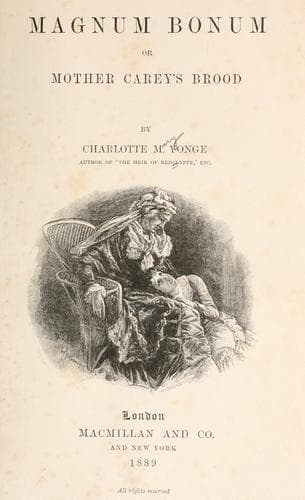
Magnum Bonum; Or, Mother Carey's BroodYonge, Charlotte M. (Charlotte Mary)
General
Magnum Bonum; Or, Mother Carey's Brood
Yonge, Charlotte M. (Charlotte Mary)
Domestic fiction; England -- Social life and customs -- 19th century -- Fiction; Religious fiction
Then followed a description of the glory and worth of the true, noble,
faithful manhood of a “happy warrior,” ever going forward and carrying
through achievements for the love of the Great Captain. Each in turn,
the protector of the weak, the redresser of wrong, the patriot, the
warrior, the scholar, the philosopher, the parent, the wife, the
sister, or the child, the healthful or the sick, whoever has that one
constraining secret, the love of Christ, has his service even here,
whether active or passive, veritably golden, the fruit unto holiness,
the end everlasting life.
Perhaps it was the cluster of young faces that led the preacher thus to
speak, and as he went on, he must have met the earnest and responsive
eyes that are sure to animate a speaker, and the power and beauty of
his words struck every one. To the Evelyns it was a new and beautiful
allegory on a familiar idea. Janet was divided between discomfort
at allusions reminding her of her secret, and on criticisms of the
description of alchemy. Her mother’s heart beat as if she were hearing
an echo of her husband’s thoughts about his Magnum Bonum. Little Armine
was thrilled as, in the awe of drawing near to his first Communion, this
golden thread of life was put into his hand. But it was Jock to whom
that discourse came like a beam of light into a dark place. When upon
the dreary vista of dull abnegation on which he had been dwelling for a
month past, came this vision of the beauty, activity, victory, and glory
of true manhood, as something attainable, his whole soul swelled and
expanded with joyful enthusiasm. The future that he had embraced as lead
had become changed to gold! Thus the whole ensuing service was to him a
continuation of that blessed hopeful dedication of himself and all his
powers. It was as if from being a monk, he had become a Red Cross Knight
of the Hospital. Yet, after his soiled, spoiled, reckless boyhood, how
could that grand manhood be attained?
Later in the afternoon, when the denizens of the hotel had gone their
several ways, some to look and listen at Benediction in the Convent
church, some to climb through the pine-woods to the Alp, some to saunter
and rest among the nearer trees, the clergyman, with his Greek Testament
in his hand, was sitting on a seat under one of the trees, enjoying the
calm of one of his few restful Sundays; when he heard a movement, and
beheld the pale thin lad, who still walked so lame, who had been so
silent at the table d’hote, and whose dark eyes had looked up with such
intensity of interest, that he had more than once spoken to them.
“You are tired,” said the clergyman, kindly making room for him.
“Thanks,” said the boy, mechanically moving forward, but then pausing
as he leant on his stick, and his eyes suddenly dimmed with tears as he
said, “Oh, sir, if you would only tell me how to begin--”
“Begin what?” said the old man, holding out his hand.
“To turn it to gold,” said Jock. “Can I, after being the mad fool I’ve
been?”
Public-domain text, read in full here on John Shaqi.
Reviews
Reviews
No reviews yet
Be the first to share your thoughts on this work.
Elsewhere in the archive
Join the Discussion
Join the discussion
Sign in to leave a comment or review.
Sign InorCreate an account