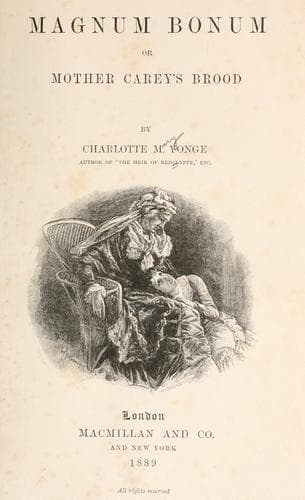
Magnum Bonum; Or, Mother Carey's BroodYonge, Charlotte M. (Charlotte Mary)
General
Magnum Bonum; Or, Mother Carey's Brood
Yonge, Charlotte M. (Charlotte Mary)
Domestic fiction; England -- Social life and customs -- 19th century -- Fiction; Religious fiction
Yes, and at that moment he was loitering at a safe distance from the
door of the now invalid and half-blind Mrs. Coffinkey, to whom the
Brownlow girls read by turns. She lived conveniently up a lane not
much frequented. This was the colloquy which ensued when the tall,
well-proportioned maiden, with her fresh, modest, happy face, tripped
down the steps:--
“So the Coffinkey is unlocked at last! Stern Proserpine relented!”
“Robert! You here?”
“You never used to call me Robert.”
“Mamma says it is time to leave off the other.”
“Perhaps she would like you to call me Mr. Robert Otway Brownlow.”
“Don’t talk of mamma in that way.”
“I would do anything my queen tells me except command my tones when
there is an attempt to stiffen her. She is not to be made into buckram.”
“Please, Robert,” as some one met and looked at them, “let me walk on by
myself.”
“What? Shall I be the means of getting you into trouble?”
“No, but I ought not--”
“The road is clear now, never mind. In town there are no gossips, that’s
one comfort. Mother Carey is propounding the plan now.”
“Oh, but we shall not go. Mamma told me so last night.”
“That was before Mother Carey had talked her over.”
“Do you think she will?”
“I am certain of it! You are a sort of child of Mother Carey’s own, you
know, and we can’t do without you.”
“Mother would miss us so, just as we are getting useful.”
“Yes, but Ellie might stay.”
“Oh! we have never been parted. We _couldn’t_ be.”
“Indeed! Is there no one that could make up to you for Ellie?”
“No, indeed!” indignantly.
“Ah, Essie, you are too much of a child yet to understand the force of
the love that--”
“Don’t,” broke in Esther, “that is just like people in novels; and mamma
would not like it.”
“But if I feel ten times far more for you than ‘the people in novels’
attempt to express?”
“Don’t,” again cried Esther. “It is Sunday.”
“And what of that, my most scriptural little queen?”
“It isn’t a time to talk out of novels,” said Esther, quickening her
pace, to reach the frequented road and throng of church-goers.”
“I am not talking out of any novel that ever was written,” said Bobus
seriously; but she was speeding on too fast to heed him, and started as
he laid a hand on her arm.
“Stay, Essie; you must not rush on like a frightened fawn, or people
will stare,” he said; and she slackened her pace, though she shook him
off and went on through the numerous passengers on the footpath, with
her pretty head held aloft with the stately grace of the startled
pheasant, not choosing to seem to hear his attempts at addressing her,
and taking refuge at last in the innermost recesses of the family seat
at Church, though it was full a quarter to five.
There the rest of the party found her, and as they did not find Bobus,
they concluded that all was safe. However, when the two Johns were
walking home with Mother Carey, Bobus joined them, and soon made
his mother fall behind with him, asking her, “I hope your eloquence
prevailed.”
Public-domain text, read in full here on John Shaqi.
Reviews
Reviews
No reviews yet
Be the first to share your thoughts on this work.
Elsewhere in the archive
Join the Discussion
Join the discussion
Sign in to leave a comment or review.
Sign InorCreate an account