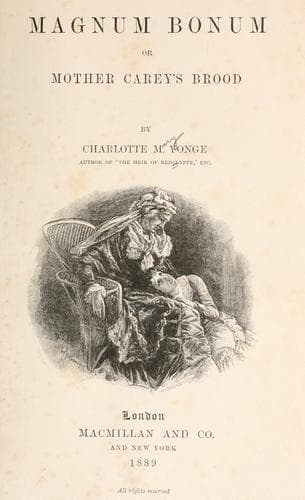
Magnum Bonum; Or, Mother Carey's BroodYonge, Charlotte M. (Charlotte Mary)
General
Magnum Bonum; Or, Mother Carey's Brood
Yonge, Charlotte M. (Charlotte Mary)
Domestic fiction; England -- Social life and customs -- 19th century -- Fiction; Religious fiction
“No, I can’t at all tell,” said Babie. “Is anything gone?”
“A book I valued very much. Some memoranda of your father were in that
desk, and I cannot find them now. You cannot tell, I suppose, whether
she was reading letters or a book?”
“It was not letters,” said Babie, “but I could not see whether it was
print or manuscript. Mother, I think she must have taken it to read and
could not put it back again because I had hidden the davenport. Oh!
I wish I hadn’t, but I couldn’t ask any one, it seemed such a wicked,
dreadful fancy that she could meddle with your papers.”
“You acted to the best of your judgment, my dear,” said Caroline. “I
ought never to have let it out of my own keeping.”
“Do you think it was lost in the bag, mother?”
“I hope not. That would be worst of all!” said Caroline. “I must ask
Janet. Don’t say anything about it, my dear. Let me think it over.”
When Caroline recollected Janet’s attempt, as related by Robert, to
break open her bureau, she had very little doubt that the book was
there. It could not have been lost in the bag, for, as she remembered,
reference had been made to it when Janet had extorted permission to go
to Zurich, and she had warned her that even these studies would not be
a qualification for the possession of the secret. Janet had then smiled
triumphantly, and said she would make her change her mind yet;
had looked, in fact, very much as Bobus did when he put aside her
remonstrances. It was not the air of a person who had lost the records
of the secret and was afraid to confess, though it was possible she
might have them in her own keeping. Caroline longed to search the
bureau, but however dishonourably Janet might have acted towards
herself, she could not break into her private receptacles without
warning. So after some consideration, she made Barbara drive her to the
station, and send the following telegraphic message to Janet’s address
at Edinburgh:--
“Come home at once. Father’s memorandum book missing. Must be searched
for.”
All that day and the next the sons wondered what was amiss with their
mother, she was so pensive, with starts of flightiness. Allen thought
she was going to have an illness, and Bobus that it was a very strange
and foolish way of taking his resistance, but all the time Armine was
going about quite unperceiving, in a blissful state. The vicar’s
sister, a spirited, active, and very winning woman of thirty-five,
had captivated him, as she did all the lads of the parish. He had been
walking about with her, being introduced to all the needs of the parish,
and his enthusiastic nature throwing itself into the cause of religion
and beneficence, which was in truth his congenial element; he was ready
to undertake for himself and his mother whatever was wanted, without a
word of solicitation, nay rather, the vicar, who thought it all far too
good to be true, held him back.
Public-domain text, read in full here on John Shaqi.
Reviews
Reviews
No reviews yet
Be the first to share your thoughts on this work.
Elsewhere in the archive
Join the Discussion
Join the discussion
Sign in to leave a comment or review.
Sign InorCreate an account