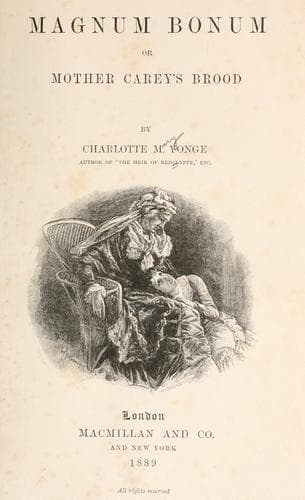
Magnum Bonum; Or, Mother Carey's BroodYonge, Charlotte M. (Charlotte Mary)
General
Magnum Bonum; Or, Mother Carey's Brood
Yonge, Charlotte M. (Charlotte Mary)
Domestic fiction; England -- Social life and customs -- 19th century -- Fiction; Religious fiction
“Your ever loving,
“MOTHER CAREY.”
“What does it all mean?” cried the bewildered girl.
“It means,” said the lawyer, “that Mrs. Brownlow has discovered a will
of the late Mr. Barnes more recent than that under which she inherited,
naming you, Miss Elvira Menella, as the sole inheritrix.”
“My dear child, let me be the first to congratulate you on your recovery
of your rights,” said Mrs. Gould, again proffering an embrace, but
again the whip was interposed, while Elvira, with her eyes fixed on Mr.
Wakefield, asked “What?” so that he had to repeat the explanation.
“Then does it all belong to me?” she asked.
“Eventually it will, Miss Menella. You are sole heiress to your great
uncle, though you cannot enter into possession till certain needful
forms of law are gone through. Mrs. Brownlow offers no obstruction, but
they cannot be rapid.”
“All mine!” repeated Elvira, with childish exultation. “What fun! I must
go and tell Sydney Evelyn.”
“A few minutes more, Miss Menella,” said Mr. Wakefield. “You ought to
hear the terms of the will.”
And he read it to her.
“I thought you told me it was to be mine. This is all you and uncle
George.”
“As your trustees.”
“Oh, to manage as the Colonel does. You will give me all the money I ask
you for. I want some pearls, and I must have that duck of a little Arab.
Uncle George, how soon can I have it?”
“We must go through the Probate Court,” he began, but his wife
interrupted--
“Ways and means will be forthcoming, my dear, though for my part I think
it would be much better taste in Mrs. Brownlow to put you in possession
at once.”
“Mr. Wakefield explained, my dear,” said her husband, “that, much as
Mrs. Brownlow wishes to do so, she cannot; she has no power. It is her
trustees.”
“Oh yes, I know every excuse will be found for retaining the property as
long as possible,” said the lady.
“Then I shall have to wait ever so long,” said the young lady. “And I do
so want the Arab. It is a real love, and Allen would say so.”
“I have another letter for you,” said Mr. Wakefield, on hearing that
name. “We will leave it with you. If you wish for further information, I
would call immediately on receiving a line at my office.”
Just then a message was brought from Mrs. Evelyn inviting Miss Menella’s
friends to stay to luncheon. It incited Elvira, who knew neither awe nor
manners, to run across the great drawing-room, leaving the doors open
behind her, to the little morning-room, where sat Mrs. Evelyn, with
Sydney, in her habit standing by the mantelpiece.
“Oh, Mrs. Evelyn,” Elvira began, “it is Mr. Wakefield and my uncle and
his wife. They have come to say it is all mine; Uncle Barnes left it all
to me.”
“So I hear from Mrs. Brownlow,” said Mrs. Evelyn gravely.
“Oh, Elfie, I am so sorry for you. Don’t you hate it?” cried Sydney.
“Oh, but it is such fun! I can do everything I please,” said the
heiress.
“Yes, that’s the best part,” said Sydney. “I do envy you the day when
you give it all back to Allen.”
Public-domain text, read in full here on John Shaqi.
Reviews
Reviews
No reviews yet
Be the first to share your thoughts on this work.
Elsewhere in the archive
Join the Discussion
Join the discussion
Sign in to leave a comment or review.
Sign InorCreate an account