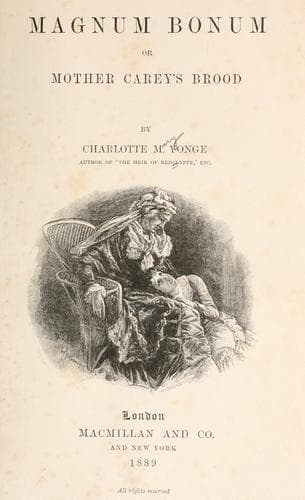
Magnum Bonum; Or, Mother Carey's BroodYonge, Charlotte M. (Charlotte Mary)
General
Magnum Bonum; Or, Mother Carey's Brood
Yonge, Charlotte M. (Charlotte Mary)
Domestic fiction; England -- Social life and customs -- 19th century -- Fiction; Religious fiction
Now Mrs. Gould, to do her justice, measured others by herself, and
really and truly believed that only accident had disconcerted a plan for
concealing the will till Elvira should have been safely married to Allen
Brownlow, and that thus it was the fixed purpose of the family to keep
her and her fortune in their hands, a purpose which every instinct bade
Mrs. Lisette Gould to traverse and overthrow, if only because she hated
such artfulness and meanness. Unfortunately, too, as she had been a
governess, and her father had been a Union doctor, she could put herself
forward as something above a farmer’s wife, indeed “quite as good as
Mrs. Brownlow.”
All Mrs. Evelyn’s civility had not redeemed her from the imputation of
being “high,” and Elvira was quite ready to call hers a very dull house.
In truth, there was only moderate gaiety, and no fastness. The ruling
interests were religious and political questions, as befitted Fordham’s
maiden session, the society was quietly high-bred, and intelligent,
and there was much attention to health; for, strong as Sydney was, her
mother would have dreaded the full whirl of the season as much for her
body as for her mind.
At all this the frivolous, idle little soul chafed and fretted, aware
that the circle was not a fashionable one, eager for far more diversion
and less restraint, and longing to join the party in Hyde Corner, where
she could always make Allen do what she pleased.
With the obtuseness of an unobservant, self-occupied mind, she was taken
by surprise when Mrs. Gould said that Mrs. Brownlow was not coming to
town, adding, “It would be very unbecoming in her, though of course she
will hold on at Belforest as long as there is any quibble of the law.”
“Oh, I don’t want to lose the season; she promised me!”
Then Mrs. Gould made a great stroke.
“My dear, you could not return to her. Not when the young man has just
broken with you. You would have more proper pride.”
“Poor Allen!” said Elvira. “If he would only let me alone, to have my
fun like other girls.”
“You see he could not afford to let you gratify your youthful spirits.
Too much was at stake, and it is most providential that things had gone
no further, and that your own good sense has preserved you to adorn a
much higher sphere.”
“Allen could be made something,” said Elvira, “I know, for he told me
he could get himself made a baronet. He always does as I tell him. Will
they be very poor, Lisette?”
“Oh no, my dear, generous child, Mrs. Brownlow was quite as well
provided for as she had any right to expect. You need have no anxieties
on that score.”
To Elvira, the change from River Hollow to the Pagoda had been from
rustic to gentle life, and thus this reply sounded plausible enough to
silence a not much awakened compassion, but she still said, “Why can’t
I go home? I’ve nowhere else to go. I could not stay at the Farm,” she
added in her usual uncomplimentary style.
Public-domain text, read in full here on John Shaqi.
Reviews
Reviews
No reviews yet
Be the first to share your thoughts on this work.
Elsewhere in the archive
Join the Discussion
Join the discussion
Sign in to leave a comment or review.
Sign InorCreate an account