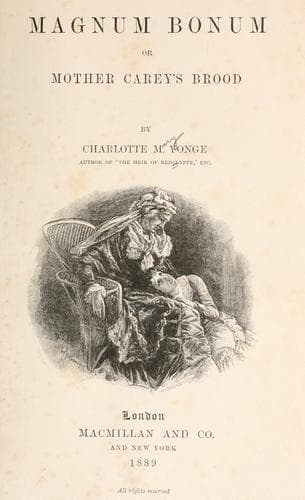
Magnum Bonum; Or, Mother Carey's BroodYonge, Charlotte M. (Charlotte Mary)
General
Magnum Bonum; Or, Mother Carey's Brood
Yonge, Charlotte M. (Charlotte Mary)
Domestic fiction; England -- Social life and customs -- 19th century -- Fiction; Religious fiction
Babie drew a long breath, and said--
“I’m glad! It was so horrid! You’ll not let him do it any more?”
“Then you decidedly would not like it?” returned her mother.
“Like it? Poor Duke! Mother! As if I could ever! A man that can’t sit in
a draught, or get wet in his feet!” cried Babie, with the utmost scorn;
and reading reproof as well as amused pity in her mother’s eyes, she
added, “Of course, I am very sorry for him; but fancy being very _sorry_
for one’s love!”
“I thought you liked wounded knights?”
“Wounded! Yes, but they’ve done something, and had glorious wounds. Now
Duke--he is very good, and it is not his fault but his misfortune; but
he is such a--such a muff!”
“That’s enough, my dear; I am quite content that my Infanta should
wait for her hero. Though,” she added, almost to herself, “she is too
childish to know the true worth of what she condemns.”
She felt this the more when Babie, who had coaxed the housekeeper into
letting her begin a private school of cookery, started up, crying--
“I must go and see my orange biscuits taken out of the oven! I should
like to send a taste to Sydney!”
Yes, Barbara was childish for nearly sixteen, and, as it struck her
mother at the moment, rather wonderfully so considering her cleverness
and romance. It was better for her that the softening should not come
yet, but, mother as she was, Caroline’s sympathies could not but be at
the moment with the warm-hearted, impulsive, generous young man, moved
out of all his habitual valetudinarian habits by his affection, rather
than with the light-hearted child, who spurned the love she did not
comprehend, and despised his ill-health. Had the young generation no
hearts? Oh no--no--it could not be so with her loving Barbara, and she
ought to be thankful for the saving of pain and perplexity.
Poor Armine was not getting much comfort out of his friend, who was too
much preoccupied to attend to what he was saying, and only mechanically
assented at intervals to the proposition that it was an inscrutable
dispensation that the will and the power should so seldom go together.
He heard all Armine’s fallen castles about chapels, schools, curates,
and sisters, as in a dream, really not knowing whether they were or were
not to be. And with all his desire to be useful, he never perceived the
one offer that would have been really valuable, namely, to carry off the
boy out of sight of the scene of his disappointment.
Fordham was compelled to stay for an uncomfortable luncheon, when
there were spasmodic jerks of talk about subjects of the day to keep
up appearances before the servants, who flitted about in such an
exasperating way that their mistress secretly rejoiced to think how soon
she should be rid of the fine courier butler.
Just as the pony-carriage came round for Armine to drive his friend back
to the station, the Colonel came in, and was an astonished spectator of
the farewells.
Public-domain text, read in full here on John Shaqi.
Reviews
Reviews
No reviews yet
Be the first to share your thoughts on this work.
Elsewhere in the archive
Join the Discussion
Join the discussion
Sign in to leave a comment or review.
Sign InorCreate an account