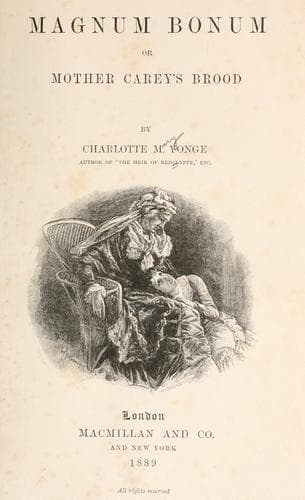
Magnum Bonum; Or, Mother Carey's BroodYonge, Charlotte M. (Charlotte Mary)
General
Magnum Bonum; Or, Mother Carey's Brood
Yonge, Charlotte M. (Charlotte Mary)
Domestic fiction; England -- Social life and customs -- 19th century -- Fiction; Religious fiction
“Bent on getting all they could while they could,” he said, quite
unjustly as to the vicar, and hardly fairly by the sister, whose demands
were far exceeded by those of her champion.
The claims of the cottages for repair, and of the school for
sufficient enlargement and maintenance to obviate a School Board,
were acknowledged; but for the rest, the Colonel said, “his sister was
perfectly at liberty. No one could blame her if she threw her balance at
the bank into the sea. She would never be called to account; but since
she asked him whether the estate was bound to assist in pulling the
church to pieces, and setting up a fresh curate to bring in more
absurdities, he could only say what he thought,” etc.
These thoughts of his were of course most offensive to Armine, who set
all down to sordid Puritan prejudice, could not think how his mother
could listen, and, when Babie stood up for her mother, went off to blend
his lamentations with those of Miss Parsons, whose resignation struck
him as heroic. “Never mind, Armine, it will all come in time. Perhaps
we are not fit for it yet. We cannot expect the world’s justice to
understand the outpouring of the saints’ liberality.”
Armine repeated this interesting aphorism to Barbara, and was much
disappointed that the shrewd little woman did not understand it, or only
so far as to say, “But I did not know that it was saintly to be liberal
with other people’s money.”
He said Babie had a prejudice against Miss Parsons; and he was so far
right that the Infanta did not like her, thought her a humbug, and
sorely felt that for the first time something had come between herself
and Armine.
Allen was another trouble. He did not agree to the retrenchments, in
which he saw no sense, and retained his horse and groom. Luckily he had
retained only one when going abroad, and at this early season he needed
no more. But his grievous anxiety and restlessness about Elvira did
not make him by any means insensible to the effects of a reduced
establishment in a large house, and especially to the handiwork of the
good woman who had been left in charge, when compared with that of the
80L cooks who had been the plague of his mother’s life.
No one, however, could wonder at his wretchedness, as day after day
passed without hearing from Elvira, and all that was known was that
she had left Mrs. Evelyn and gone to stay with Lady Flora Folliott, a
flighty young matron, who had been enraptured with her beauty at a table
d’hote a year ago, and had made advances not much relished by the rest
of the party.
No more was to be learnt till Lucas found a Saturday to come down.
Before he could say three words, he was cross-examined. Had he seen
Elvira?
“Several times.”
“Spoken to her?”
“Yes.”
“What had she said?”
“Asked him to look at a horse.”
“Did she know he was coming home?”
“Yes.”
“Had she sent any message?”
Public-domain text, read in full here on John Shaqi.
Reviews
Reviews
No reviews yet
Be the first to share your thoughts on this work.
Elsewhere in the archive
Join the Discussion
Join the discussion
Sign in to leave a comment or review.
Sign InorCreate an account