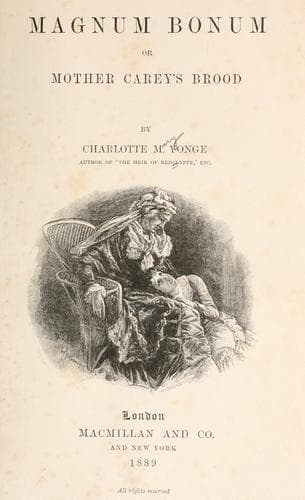
Magnum Bonum; Or, Mother Carey's BroodYonge, Charlotte M. (Charlotte Mary)
General
Magnum Bonum; Or, Mother Carey's Brood
Yonge, Charlotte M. (Charlotte Mary)
Domestic fiction; England -- Social life and customs -- 19th century -- Fiction; Religious fiction
“There, you have the consent of your first acquaintance,” said Carey,
while the bird, excited by one of those mysterious likings that her
kind are apt to take, held her grey head to Mr. Ogilvie to be scratched,
chuckling out, “All Mother Carey’s chickens,” and Janet exclaimed--
“That’s an adoption.”
The troop were climbing the stairs to the third story, where Armine and
Bobus were already within an octagon room, corresponding to the little
hall below, and fitted with presses and shelves, belonging to the
store-room of the former thrifty inhabitant; but now divided between
the six children, Mother Carey, as Babie explained, being “Mine own, and
helping me more specially.”
The table was likewise common to all; but one of the laws of the place
was that everything left there after twelve o’clock on Saturday was,
as Babie’s little mouth rolled out the long words, “confiscated by the
inexorable Eumenides.”
“And who are they?” asked Mr. Ogilvie, who was always much entertained
by the simplicity with which the little maid uttered the syllables as if
they were her native speech.
“Janet, and Nurse, and Emma,” she said; “and they really are
inex-o-rable. They threw away my snail shell that a thrush had been
eating, though I begged and prayed them.”
“Yes, and my femur of a rabbit,” said Armine, “and said it was a
nasty old bone, and the baker’s Pincher ate it up; but I did find my
turtle-dove’s egg in the ash-heap, and discovered it over again, and you
don’t see it is broken now; it is stuck down on a card.”
“Yes,” said his mother, “it is wonderful how valuable things become
precisely at twelve on Saturday.”
Each had some department: Janet’s, which was geology, was the fullest,
as she had inherited some youthful hoards of her father’s; Bobus’s,
which was botany, was the neatest and most systematic. Mary thought at
first that it did not suit him; but she soon saw that with him it was
not love of flowers, but the study of botany. He pronounced Jock’s
butterflies to be perfectly disgraceful.
“You said you’d see to them,” returned Jock.
“Yes, I shall take up insects when I have done with plants,” said Bobus,
coolly.
“And say, ‘Solomon, I have surpassed thee’?” asked Mr. Ogilvie.
Bobus looked as if he did not like it; but his mother shook her head
at him as one who well deserved the little rebuke for self-sufficiency.
There was certainly a wonderful winning way about her--there was a
simplicity of manner almost like that of Babie herself, and yet the
cleverness of a highly-educated woman. Mary Ogilvie did not wonder
at what Mr. and Mrs. Acton had said of the charm of that unpretending
household, now broken up.
There was, too, the perception that, beneath the surface on which, like
the children, she played so lightly, there were depths of sorrow that
might not be stirred, which added a sweetness and pathos to all she said
and did.
Public-domain text, read in full here on John Shaqi.
Reviews
Reviews
No reviews yet
Be the first to share your thoughts on this work.
Elsewhere in the archive
Join the Discussion
Join the discussion
Sign in to leave a comment or review.
Sign InorCreate an account