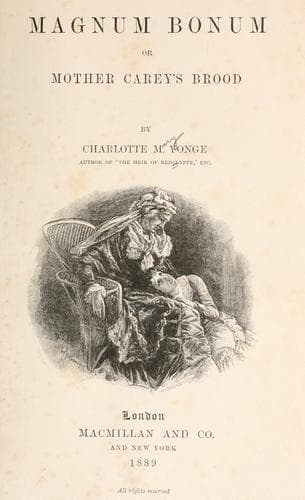
Magnum Bonum; Or, Mother Carey's BroodYonge, Charlotte M. (Charlotte Mary)
General
Magnum Bonum; Or, Mother Carey's Brood
Yonge, Charlotte M. (Charlotte Mary)
Domestic fiction; England -- Social life and customs -- 19th century -- Fiction; Religious fiction
Mr. and Mrs. Acton came to a farmhouse at Redford, about a mile and a
half off, where Mr. Acton was to lay up a store of woodland and home
sketches, and there were daily meetings for walks, and often out-of-door
meals. Mr. Ogilvie declared that he was thus much more rested than by a
long expedition in foreign scenery, and he and his sister stayed on,
and usually joined in the excursion, whether it were premeditated or
improvised, on foot, into copse or glade, or by train or waggonette, to
ruined abbey or cathedral town.
Then came two sisters, whom old Mrs. Brownlow had befriended when
the elder was struggling, as a daily governess, to provide home and
education for the younger. Now, the one was a worthy, hard-working
law-copier, the other an artist in a small way, who had transmogrified
her name of Jane into Juanita or Nita, wore a crop, short petticoats,
and was odd. She treated Janet on terms of equal friendship, and was
thus a much more charming companion than Jessie. They always came into
cheap sea-side lodgings in the vacation, but this year had settled
themselves within ten minutes walk of the Folly, a title which became
more and more applicable, in Kenminster eyes, to the Pagoda, and above
all in those of its proper owner. Mrs. Robert Brownlow, in the calm
dignity of the heiress, in a small way, of a good family, had a bare
toleration for professional people, had regretted the vocation of her
brother-in-law, and classed governesses and artists as “that kind of
people,” so that Caroline’s association with them seemed to her
absolute love of low company. She would have stirred up her husband
to remonstrate, but he had seen more of the world than she had, and
declared that there was no harm in Caroline’s friends. “He had met Mr.
Acton in the reading-room, smoked pipes with him in the garden, and
thought him a very nice fellow; his wife was the daughter of poor
Cartwright of the Artillery, and a sensible ladylike woman as ever he
saw.”
With a resigned sigh at the folly of mankind, his wife asked, “How about
the others? That woman with the hair? and that man with the velvet coat?
Jessie says Jock told her that he was a mere play-actor!”
“Jock told Jessie! Nonsense, my dear! The man is going out to China
in the tea trade, and is come to take leave. I believe he did sing in
public at one time; but Joe attended him in an illness which damaged
his voice, and then he put him in the way of other work. You need not be
afraid. Joe was one of the most particular men in the world in his own
way.”
Public-domain text, read in full here on John Shaqi.
Reviews
Reviews
No reviews yet
Be the first to share your thoughts on this work.
Elsewhere in the archive
Join the Discussion
Join the discussion
Sign in to leave a comment or review.
Sign InorCreate an account