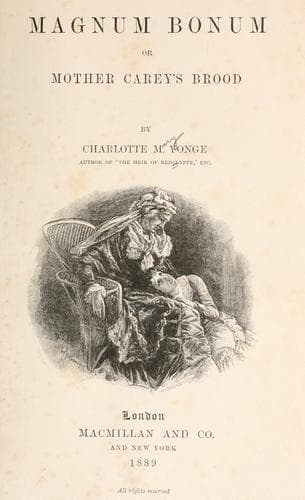
Magnum Bonum; Or, Mother Carey's BroodYonge, Charlotte M. (Charlotte Mary)
General
Magnum Bonum; Or, Mother Carey's Brood
Yonge, Charlotte M. (Charlotte Mary)
Domestic fiction; England -- Social life and customs -- 19th century -- Fiction; Religious fiction
Thus they did not set out on their homeward walk, over fragrant
heath and dewy lanes, till just as the stars were coming out, and a
magnificent red moon, scarcely past the full, was rising in the east,
and the long rest, and fresh dewiness after the day’s heat, gave a
delightful feeling of exhilaration.
Babie went skipping about in the silvery flood of light, quite wild with
delight as they came out on the heath, and, darting up to Mr. Ogilvie,
asked if now he did not think they might really see a fairy.
“Perhaps I do,” he said.
“Oh where, where, show me?”
“Ah! you’re the one that can’t see her.”
“What, not if I did my eyes with that Euphrasia and Verbena
officinalis?” catching tight hold of his hand, as a bright red light
went rapidly moving in a straight line in the valley beneath their feet.
“Robin Goodfellow,” said Mr. Hughes, overhearing her, and immediately
began to sing--
“I know a bank”--
Then the curate, as he finished, began to sing some other appropriate
song, and Nita Ray and others joined in. It was very pretty, very
charming in the moonlight, very like “Midsummer Night’s Dream;” but Mary
Ogilvie, who was a good way behind, felt a start of dismay as the clear
notes pealed back to her. She longed to suggest a little expediency;
but she was impeded; for poor Miss Ray, entirely unused to long country
walks and nocturnal expeditions, and further tormented by tight boots,
was panting up the hill far in the rear, half-frightened, and a good
deal distressed, and could not, for very humanity’s sake, be left
behind.
“And after all,” thought Mary, as peals of the boys’ merry laughter came
to her, and then again echoes of “spotted snakes with double tongue”
awoke the night echoes; “this is such a solitary place that it cannot
signify, if they will only have the sense to stop when we get into the
roads.”
But they hadn’t. Mary heard a chorus from “Der Freischutz,” beginning
just as she was dragging her companion over a stile, which had been
formidable enough by day, but was ten times worse in the confusing
shadows. That brought them into a lane darkened by its high hedges,
where there was nothing for it but to let Miss Ray tightly grapple her
arm, while the songs came further and further on the wind, and Mary
felt the conviction that middle-aged spinsters must reckon on being
forgotten, and left behind alike by brothers, sisters, and friends.
Public-domain text, read in full here on John Shaqi.
Reviews
Reviews
No reviews yet
Be the first to share your thoughts on this work.
Elsewhere in the archive
Join the Discussion
Join the discussion
Sign in to leave a comment or review.
Sign InorCreate an account