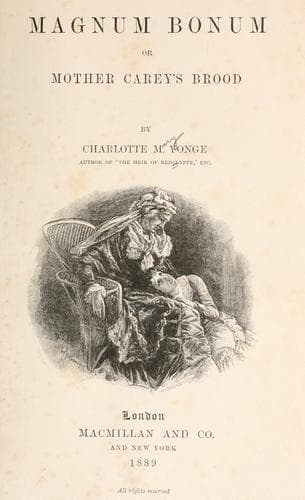
Magnum Bonum; Or, Mother Carey's BroodYonge, Charlotte M. (Charlotte Mary)
General
Magnum Bonum; Or, Mother Carey's Brood
Yonge, Charlotte M. (Charlotte Mary)
Domestic fiction; England -- Social life and customs -- 19th century -- Fiction; Religious fiction
Poor Mary! she had expected her friend to be more reasonable and less
defensive; but she remembered that even at school Clara had always
protected Caroline whenever she had attempted to lecture her. All she
further tried to say was--
“Then you won’t help me to advise her to be more guarded, and not shock
them?”
“I will not tease the poor little thing, when she has enough to torment
her already. If you had known her husband, and watched her last winter,
you would be only too thankful to see her a little more like herself.”
Mary was silent, finding that she should only argue round and round if
they went on, and feeling that Clara thought her old-maidish, and could
not enter into her sense that, the balance-weight being gone, gusts of
wind ought to be avoided. She sat wondering whether she herself was
prim and old-maidish, or whether she was right in feeling it a duty to
expostulate and deliver her testimony.
There was no doing it on this day. Carey was always surrounded by
children and guests, and in an eager state of activity; but though again
they all went home in the cool of the evening, an attempt to sing in
the second-class carriage, which they filled entirely, was quashed
immediately--no one knew how, and nothing worse happened than that a
very dusty set, carrying odd botanical, entomological, and artistic
wares, trailed through the streets of Kenminster, just as Mrs.
Coffinkey, escorted by her maid, was walking primly home from drinking
tea at the vicarage.
Still Mary’s reflections only strengthened her resolution. On the next
day, which was Sunday, she ascended to the Folly, at about four o’clock
in the afternoon, and found the family, including the parrot, spread out
upon the lawn under the shade of the acacia, the mother reading to them.
“Oh, please don’t stop, mother,” cried Babie; while the more courteous
Armine exclaimed--
“Miss Ogilvie, don’t you like to hear about Bevis and Jocelin Joliffe?”
“You don’t mind waiting while we finish the chapter,” added their
mother; “then we break up our sitting.”
“Pray go on with the chapter,” said Mary, rather coolly, for she was a
good deal taken aback at finding them reading “Woodstock” on a Sunday;
“but afterwards, I do want to speak to you.”
“Oh! don’t want to speak to me. The Colonel has been speaking to me,”
she said, with a cowering, shuddering sort of action, irresistibly
comic.
“And he ate up half our day,” bemoaned more than one of the boys.
Miss Ogilvie sat down a little way off, not wishing to listen
to “Woodstock” on a Sunday, and trying to work out the difficult
Sabbatarian question in her mind.
“There!” said Caroline, closing the book, amid exclamations of “I know
who Lewis Kerneguy was.” “Wasn’t Roger Wildrake jolly?” “O, mother,
didn’t he cut off Trusty Tomkins’ head?” “Do let us have a wee bit more,
mother; Miss Ogilvie won’t mind.”
But Carey saw that she did mind, and answered--
Public-domain text, read in full here on John Shaqi.
Reviews
Reviews
No reviews yet
Be the first to share your thoughts on this work.
Elsewhere in the archive
Join the Discussion
Join the discussion
Sign in to leave a comment or review.
Sign InorCreate an account