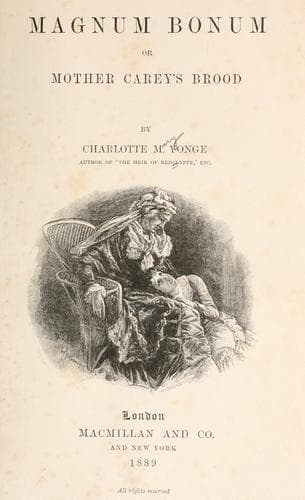
Magnum Bonum; Or, Mother Carey's BroodYonge, Charlotte M. (Charlotte Mary)
General
Magnum Bonum; Or, Mother Carey's Brood
Yonge, Charlotte M. (Charlotte Mary)
Domestic fiction; England -- Social life and customs -- 19th century -- Fiction; Religious fiction
“Yes,” said her mother, looking at her rather wonderingly; and
adding, as Janet coloured up to the eyes, “My dear, have you any other
association with the name?”
Many a time Janet had longed to tell all she knew; now, when so good an
opportunity had come, all was choked back by the strange leaden weight
of reserve, and shame in that long reserve.
She opened her eyes and stared as stupidly at her mother as Robin
could have done, feeling an utter incapacity of making any reply; and
Caroline, who had for a moment thought she understood, was baffled,
and durst not pursue the subject for fear of betraying her own secret,
deciding within herself that Janet might have caught up the word without
understanding.
They were interrupted the next minute, and Janet ran away, feeling that
she had had an escape, yet wishing she had not.
Caroline did effectually shelter her nephews under her general term “the
boys,” and if their mother was not conciliated, their fellow-feeling
with her was strengthened, as well as their sense of honour. Nay, Johnny
actually spent the next half-holiday in walking three miles and back to
his old nurse, whom he beguiled out of a basket of plums--hard, little
blue things, as unlike magnum bonums as could well be, but which his
aunt received as they were meant, as full compensation; nay, she took
the pains to hunt up a recipe, and have them well preserved, in hopes of
amazing his mother.
It was indeed one difficulty that the two sisters-in-law had such
different notions of the aim and end of economy. The income at Kencroft
had not increased with the family, which numbered eight, for there were
two little boys in the nursery, and it was only by diligent housewifery
that Mrs. Brownlow kept up the somewhat handsome establishment she had
started with at her marriage. Caroline felt that she neither could nor
would have made herself such a slave to domestic details; yet this was
life and duty and interest to Ellen. Where one sister would be unheeding
of shabby externals, so that all her children might be free and on an
equality, if they did not go beyond her, in all enjoyments, physical,
artistic, or intellectual; the other toiled to keep up appearances, kept
her children under restraint and in the background, and made all sorts
of unseen sacrifices to the supposed duty of always having a handsome
dinner for whomsoever the Colonel might bring in, and keeping the
horses, carriages, and servants that she thought his due.
But then Ellen had a husband, and, as Caroline sighed to herself, that
made all the difference! and she was no Serene Highness, and had no
dignity.
The three girls from Kencroft did actually become pupils at the Folly,
but the beginnings were not propitious, for, in her new teacher’s eyes,
Jessie knew nothing accurately, but needed to have her foundations
looked to--to practise scales, draw square boxes, and work the four
first rules of arithmetic.
Public-domain text, read in full here on John Shaqi.
Reviews
Reviews
No reviews yet
Be the first to share your thoughts on this work.
Elsewhere in the archive
Join the Discussion
Join the discussion
Sign in to leave a comment or review.
Sign InorCreate an account