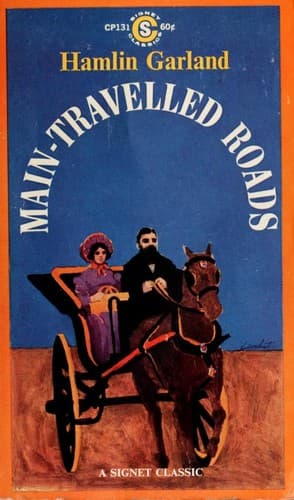
Mississippi River Valley -- Fiction; Short stories; Western stories
This he was able to do, for his corn-rows ran alongside the road leading
to Cedarville, and his neighbors were passing almost all hours of the
day.
It would have softened Jane Ripley's heart could she have seen his bent
and stiffened form among the corn-rows, the cold wind piercing to the
bone through his threadbare and insufficient clothing. The rising wind
sent the snow rattling among the moaning stalks at intervals. The cold
made his poor dim eyes water, and he had to stop now and then to swing
his arms about his chest to warm them. His voice was hoarse with
shouting at the shivering team.
That night as Mrs. Ripley was clearing the dishes away she got to
thinking about the departure of the next day, and she began to soften.
She gave way to a few tears when little Tewksbury Gilchrist, her
grandson, came up and stood beside her.
"Gran'ma, you ain't goin' to stay away always, are yeh?"
"Why, course not, Tukey. What made y' think that?"
"Well, y' ain't told us nawthin' 't all about it. An' yeh kind o' look
's if yeh was mad."
"Well, I ain't mad; I'm jest a-thinkin', Tukey. Y' see, I come away from
them hills when I was a little girl a'most; before I married y'r
grandad. And I ain't never been back. 'Most all my folks is there,
sonny, an' we've been s' poor all these years I couldn't seem t' never
git started. Now, when I'm 'most ready t' go, I feel kind a queer--'s if
I'd cry."
And cry she did, while little Tewksbury stood patting her trembling
hands. Hearing Ripley's step on the porch, she rose hastily and, drying
her eyes, plunged at the work again.
Ripley came in with a big armful of wood, which he rolled into the
wood-box with a thundering crash. Then he pulled off his mittens,
slapped them together to knock off the ice and snow, and laid them side
by side under the stove. He then removed cap, coat, blouse, and finally
his boots, which he laid upon the wood-box, the soles turned toward the
stove-pipe.
As he sat down without speaking, he opened the front doors of the stove,
and held the palms of his stiffened hands to the blaze. The light
brought out a thoughtful look on his large, uncouth, yet kindly, visage.
Life had laid hard lines on his brown skin, but it had not entirely
soured a naturally kind and simple nature. It had made him penurious and
dull and iron-muscled; had stifled all the slender flowers of his
nature; yet there was warm soil somewhere hid in his heart.
"It's snowin' like all p'ssessed," he remarked finally. "I guess we'll
have a sleigh-ride to-morrow. I calc'late t' drive y' daown in
scrumptious style. If yeh must leave, why, we'll give yeh a whoopin' old
send-off--won't we, Tukey?"
Nobody replying, he waited a moment. "I've ben a-thinkin' things over
kind o' t'-day, mother, an' I've come t' the conclusion that we have
been kind o' hard on yeh, without knowin' it, y' see. Y' see I'm kind o'
easy-goin', 'an' little Tuke he's only a child, an' we ain't c'nsidered
how you felt."
Public-domain text, read in full here on John Shaqi.
Reviews
Reviews
No reviews yet
Be the first to share your thoughts on this work.
Elsewhere in the archive
Join the Discussion
Join the discussion
Sign in to leave a comment or review.
Sign InorCreate an account