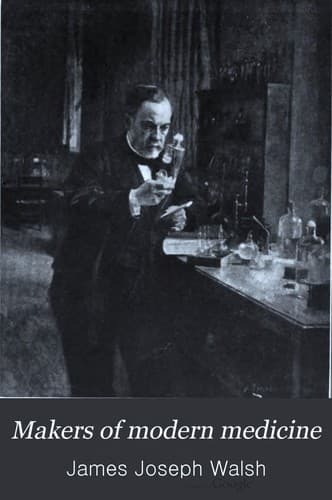
Makers of Modern MedicineWalsh, James J. (James Joseph)
History
Makers of Modern Medicine
Walsh, James J. (James Joseph)
Medicine -- Biography
Here, of course, was scientific intuition running far beyond medical
knowledge, and pointing out a serious danger and the best means of
avoiding it. There is scarcely a subject touched upon in Dr. Graves'
clinical lectures, however, which is not illuminated in this way by
precious sidelights, many of which unfortunately were obscured by
medical {176} theories, and conclusions founded on them without due
experience.
We have already said that his careful clinical observations led him to
separate the type of disease which has since come to be known as
Graves' disease from a number of other forms of nervous disturbances
of the heart rhythm. There is at least one other class of disease
usually considered to be much more modern, the type of affection known
as Raynaud's disease, or a tendency to spontaneous stoppage of the
circulation in the extremities, and also the other type now known as
Weir Mitchell's disease, or erythromelalgia, in which there is
suffused redness and pain in the extremities, examples of which Graves
picked out from his hospital service and described in such a way that
it is easy to recognize them even at this distance of time. His two
volumes of clinical lectures on the practice of medicine are much more
than an index of the medical teaching of his time. They contain
anticipations of many a supposed after-discovery, besides an immense
amount of very practical observations made at the bedside, and
valuable hints for treatment, the result of his personal experience.
One of the best proofs of the greatness of the work accomplished by
Graves is to be found in the tribute to his character, and what he
achieved, by Professor Trousseau, who was at the time the acknowledged
leader of the clinicians of Europe. He said:
"For many years I have spoken of Graves in my clinical lectures; I
recommend the perusal of his work; I entreat those of my pupils who
understand English to consider it as their breviary; I say and
repeat that, of all the practical works published in our time, I am
acquainted with none more useful, more intellectual; and I have
always regretted that the clinical lectures of the great Dublin
practitioner have not been translated into our language."
{177}
A little later in the same lecture he said:
"And nevertheless, when he inculcated the necessity of giving
nourishment in long-continued fevers, the Dublin physician,
single-handed, assailed an opinion which appeared to be justified by
the practice of all ages; for low diet was then regarded as an
indispensable condition in the treatment of fevers. Had he rendered
no other services than that of completely reversing the medical
practice upon this point, Graves would, by that act alone, have
acquired an indefeasible claim to our gratitude."
His tribute closes with the following very striking passage:
Public-domain text, read in full here on John Shaqi.
Reviews
Reviews
No reviews yet
Be the first to share your thoughts on this work.
Elsewhere in the archive
Join the Discussion
Join the discussion
Sign in to leave a comment or review.
Sign InorCreate an account