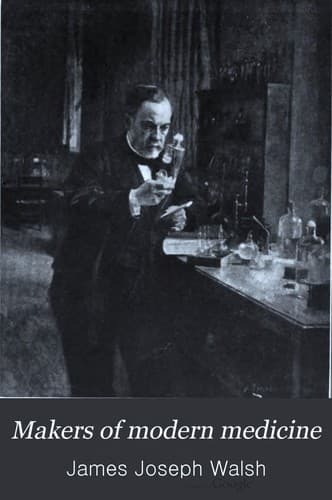
Makers of Modern MedicineWalsh, James J. (James Joseph)
History
Makers of Modern Medicine
Walsh, James J. (James Joseph)
Medicine -- Biography
It is interesting to note that before he left Edinburgh he published
his first medical work, a treatise on the use of the stethoscope,
which was undoubtedly the means of bringing that instrument--and with
it Laennec's fruitful system of physical diagnosis by means of
auscultation--to the general notice of the English-speaking medical
profession. Even after all that has been written on the subject, it
remains a very valuable little book. It was dedicated to the famous
Cullen, who had already published a series of cases which had been
illustrated by the use of the stethoscope, and to whom Stokes probably
owed the idea of the need for a formal little treatise on the subject.
It is typical of the slow adoption of medical novelties even when they
are of great importance that more than ten years afterward, old-time,
though distinguished, physicians not infrequently made fun of Stokes
for spending so much time in the study of cases with the stethoscope,
since in their opinion it was little more than a toy. This was done in
no bitter, carping spirit, but with the most friendly complacency and
condescension. Stokes, however, intensely practical in his way,
realized the value of the instrument, and as the result of his
teaching it soon began to be more generally used; thus introducing
into English-speaking medical circles that exact knowledge of diseases
of the chest which can only be obtained by means of this little
instrument and the methods of auscultation which are associated with
it.
Immediately after graduation, Stokes settled down in his native city
to practise. In 1826, when Stokes was only twenty-two, Dublin was
visited by one of those epidemics of typhus fever which were so common
in the first half of the {189} nineteenth century, and which consisted
evidently, at least to a great degree, of what we now call typhoid
fever, but intermixed with many cases of the real, dread typhus. The
mortality in such epidemics, as we have reason to know from statistics
here in New York, was always over twenty-five per cent, and often
reached far above fifty per cent. The manner of contagion was unknown,
only it was very well understood that those much in contact with the
patients were likely to contract the disease. Among the poorer classes
in Dublin the fever raged with virulence, but young Stokes devoted
himself to the care of patients to an extent that severely taxed his
physical powers of endurance. He devoted himself especially to the
poorer classes. He did not contract the fever during the height of the
epidemic in 1826, but he did in 1827, when it recurred, but
fortunately he suffered in the mild form.
Public-domain text, read in full here on John Shaqi.
Reviews
Reviews
No reviews yet
Be the first to share your thoughts on this work.
Elsewhere in the archive
Join the Discussion
Join the discussion
Sign in to leave a comment or review.
Sign InorCreate an account