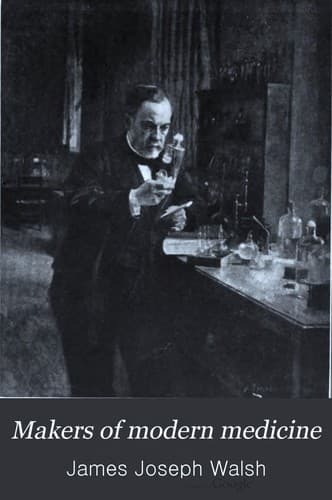
Makers of Modern MedicineWalsh, James J. (James Joseph)
History
Makers of Modern Medicine
Walsh, James J. (James Joseph)
Medicine -- Biography
In 1843, when the Medical Charities Bill was brought forward, Stokes
and Cusack united in the effort to procure for these devoted men an
amelioration of the conditions under which they labored. They repaired
to London to give evidence on the subject before the House of Commons.
Both these friends had had to deplore the loss of many of their
dearest and most promising pupils, who, after a short experience of
country practice, had fallen victims to fever contracted in the
discharge of their duties. They pleaded that in all justice the
remuneration for attendance on fever hospitals and dispensaries should
be fixed at a liberal scale, and that some provision ought to be made
for the widows and children of gentlemen who had lost their lives in
the public service. They collected statistics which proved that during
a period of twenty-five years the mortality of the medical
practitioners of Ireland was twenty-four per cent., while in most
instances the cause of death was typhus fever. They {191} showed that,
on the authority of Inspector-General Marshall, the comparative
mortality of combatant officers in the army was less than half that,
amounting to only ten and a quarter per cent. It was little to be
wondered at that William Stokes should say, in answer to the
chairman's question regarding the existence of any special risk to the
medical officer in Ireland: "Such a number of my pupils have been cut
off by typhus fever as to make me feel very uneasy when any of them
take a dispensary office in Ireland. I look upon it almost as going
into battle." Again he observes: "The medical practitioners in Ireland
are placed in a position very different from and far more serious than
that of their brethren in Great Britain. . . . . The Irish physician
is often exposed to contagion in its most concentrated force when
himself under the influence of cold, wet, fatigue, and hunger, as he
labors among the poor, passing from hovel to hovel in wild and
thinly-populated but extensive districts. He has often to ride for
many hours in the worst weather, and at night, enduring great fatigue,
while himself a prey to mental as well as physical suffering; for if
we add to such labor the injurious influence which the knowledge of
danger must have on the system of a man feeling that he is struck down
by the disease under which he has seen so many sink, and tortured by
the thought of leaving a young family unprovided for, we can
understand how it happens that the country is so often deprived by
death of so many of its best educated and most devoted servants."
Public-domain text, read in full here on John Shaqi.
Reviews
Reviews
No reviews yet
Be the first to share your thoughts on this work.
Elsewhere in the archive
Join the Discussion
Join the discussion
Sign in to leave a comment or review.
Sign InorCreate an account