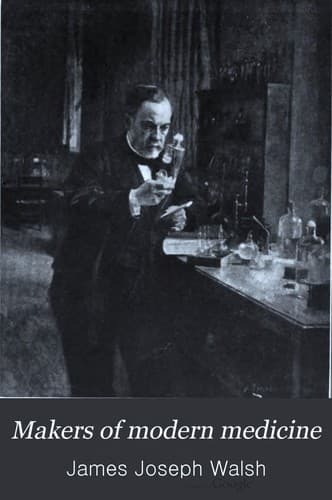
Makers of Modern MedicineWalsh, James J. (James Joseph)
History
Makers of Modern Medicine
Walsh, James J. (James Joseph)
Medicine -- Biography
"We must train the patient gradually but steadily to the giving up
of all luxurious habits. He must adopt early hours, and pursue a
system of graduated muscular exercises; and it will often happen
that, after perseverance in this system, the patient will be enabled
to take an amount of exercise with pleasure and advantage which at
first was totally impossible owing to the difficulty of breathing
which followed exertion. The treatment by muscular exercise is
obviously more proper in younger persons than in those advanced in
life. The symptoms of debility of the heart are often removable by a
regulated course of gymnastics or by pedestrian exercise, even in
mountainous countries, such as Switzerland, or the Highlands of
Scotland or of Ireland. We may often observe in such persons the
occurrence of what is commonly known as 'getting the second wind;'
that is to say, during the first period of the day the patient
suffers from dyspnoea and palpitation to an extreme degree, but by
persevering, without overexertion, or after a short rest, he can
finish his day's work and even ascend high mountains with facility.
In those advanced in life, however, as has been remarked, the
frequent complications with atheromatous disease of the aorta and
affections of the liver and lungs must make us more cautious in
recommending the course now specified."
{194}
If any proof of Stokes' ability as an observer and a teacher were
needed it would be readily found in his original description of the
form of respiratory disturbance since known as Cheyne-Stokes
respiration. The passage is besides a model of succinct completeness
of description that would well deserve to be in the commonplace book
of physicians who write, for so many of them need to imitate his
conciseness and clarity. It is to be found in his book _Diseases of
the Heart and the Aorta_, p 336.
"A form of respiratory distress, peculiar to this affection (fatty
degeneration of the heart), consisting of a period of apparently
perfect apnoea, succeeded by feeble and short inspirations, which
gradually increase in strength and depth until the respiratory act
is carried to the highest pitch of which it seems capable, when the
respirations, pursuing a descendant scale, regularly diminished
until the commencement of another apnoeal period. During the height
of the paroxysm the vesicular murmur becomes intensely puerile."
Public-domain text, read in full here on John Shaqi.
Reviews
Reviews
No reviews yet
Be the first to share your thoughts on this work.
Elsewhere in the archive
Join the Discussion
Join the discussion
Sign in to leave a comment or review.
Sign InorCreate an account