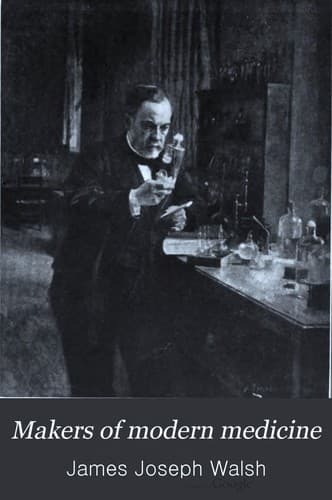
Makers of Modern MedicineWalsh, James J. (James Joseph)
History
Makers of Modern Medicine
Walsh, James J. (James Joseph)
Medicine -- Biography
It would appear probable that because of the traditions of Jesuit
teachings that held over at the school in Coblentz, and perhaps, too,
because of the presence of some of the old masters and teachers
trained by them, Müller knew the ancient languages so well. He made
his own translations of Plato and Aristotle, and consulted the latter
especially always in the original and had a lifelong reverence for the
great Greek philosophic naturalist's work, Latin he used {225} so well
as to speak it readily, and practice in the disputations of the
University at Bonn made the language still more familiar to him. It
was said that he wrote Latin better than German. After the fall of
Napoleon the Prussian government took up the reorganization of the
schools in this part of the Rhineland, and Müller became more
interested in scientific studies. At this time he became devoted to
mathematics, which he studied under the old pupil of Pestalozzi,
Professor Leutzinger, to whom Müller, in the sketch of his life
prefixed to his thesis at the university, expressed the feeling that
he owed a special debt of gratitude.
During his school days Müller became a collector, as we have said, of
natural objects. He was especially interested in butterflies for a
time, and collected all the species in the country around. He had a
curious dislike for spiders which remained with him all his life. He
was able to overcome this, however, and made important studies of that
insect's eyes, and of its changing expressions under the influence of
fear or when about to fall upon its prey.
His feeling with regard to the insect is an index of a certain
feminine quality of mind that had a characteristic expression in later
life in his dislike for vivisection. He could not bring himself to the
conclusion that animals must be sacrificed in the midst of horrible
pain unless there was some very definite scientific point to be
determined, and unless every precaution was taken to avoid inflicting
needless suffering. Even then he preferred that others should do this
work and more than once took occasion to point out the fallacy of
physiological observations founded on animal experimentation under
such anomalous circumstances, and insisted that very frequently the
results gave conclusions only by analogy and not by any strict logic
of animal similarity or absolute physiological nexus.
{226}
Public-domain text, read in full here on John Shaqi.
Reviews
Reviews
No reviews yet
Be the first to share your thoughts on this work.
Elsewhere in the archive
Join the Discussion
Join the discussion
Sign in to leave a comment or review.
Sign InorCreate an account