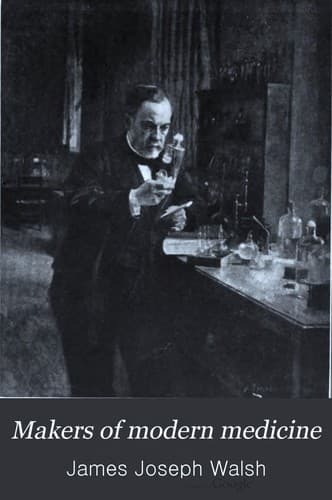
Makers of Modern MedicineWalsh, James J. (James Joseph)
History
Makers of Modern Medicine
Walsh, James J. (James Joseph)
Medicine -- Biography
"The special researches of the Bonn epoch are those of the minute
structure and anatomy of the glands. They put an end to the
controversy which had existed so long between adherents of Malpighi
and Ruysch, concerning the sacculated extremities of the glandular
follicles, and obtained for us a correct knowledge of these
important organs throughout the whole animal kingdom. Perhaps his
most important work is that of the Ducts of Müller, the structures
(named after him) which form so important a part of the
genito-urinary system in the embryo."
Practically all this had been accomplished before he was {234} quite
thirty-two years of age. In the autumn of 1832, Rudolphi, the
professor of physiology at Berlin, died. As Virchow says, candidates
sprung up on every side, and some who were the least qualified
considered themselves best fitted for the position. Müller took an
unusual step which illustrated his decision in character, though in
any other it would have seemed an evidence of conceit. He declared, in
an open letter, laid before the Minister of Prussia, that his claims
were superior to those of any other living physiologist, except John
Frederick Meckel. So powerful was the impression produced upon the
minister by this letter that he immediately appointed Müller to the
vacant chair.
Not long after his appointment to the chair of physiology at the
University of Berlin Müller completed the well-known "Hand-book of
Physiology," which established his reputation. The book is sometimes
spoken of as an experimental physiology, but this is not correct.
Müller was no more a mere experimentalist than Haller, and he,
himself, heartily detested the tendency which experimental physiology
had assumed in France, especially under the influence of Magendie.
Part of Müller's aversion to experimental physiology was aesthetic. He
could not bear the idea of inflicting so much pain as many of his
colleagues inflicted without a thought. In his panegyric of Rudolphi,
Müller says: "Rudolphi looked upon physiological experiments as having
no relation to anatomical accuracy, and it is no wonder that this
admirable man, who had at every opportunity expressed his abhorrence
of vivisection, took up a hostile position against all hypotheses and
conclusions insufficiently established upon physiological
experiments." Müller adds: "We could not have failed to share his
righteous indignation, had we seen how many physiologists were using
every effort to reduce physiology to an experimental science by the
live dissection and agonies {235} of innumerable animals, undertaken
without any definite plan, and yielding often only insignificant and
imperfect results."
Public-domain text, read in full here on John Shaqi.
Reviews
Reviews
No reviews yet
Be the first to share your thoughts on this work.
Elsewhere in the archive
Join the Discussion
Join the discussion
Sign in to leave a comment or review.
Sign InorCreate an account