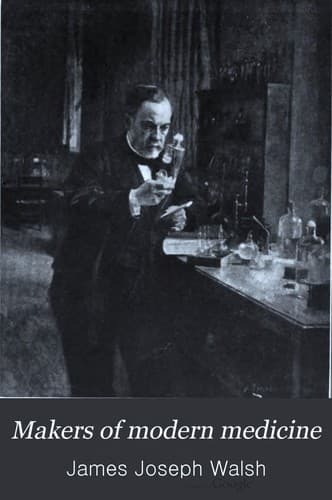
Makers of Modern MedicineWalsh, James J. (James Joseph)
History
Makers of Modern Medicine
Walsh, James J. (James Joseph)
Medicine -- Biography
The number of positive facts which Müller brought to light in the most
diverse departments of science is almost beyond calculation, and yet
it is astonishing how seldom the slightest error, or even an
incomplete observation, can be found in his work. On the other hand,
it has happened, over and over again, that when the correctness of his
observations in the beginning seemed according to other investigators
to be dubious, they have come eventually to be acknowledged as
representing the truth. As a rule, he went over every set of
observations three times. During the second series he wrote about
them. He always repeated the experiments on which his observations
were founded while his material was going through the press. His
manuscripts were a mass of corrections; notwithstanding this, his
proof sheets were the despair of the printers.
Müller accomplished all this only by the most careful husbanding of
his time. He knew how to make use even of the ends of hours and brief
intervals which others waste without a thought about them. He used to
call these periods of short duration between the duties "the gold-dust
of time," and said that he did not wish to lose a particle of it. In
the quarter of an hour between two lectures it was not an unusual
thing to find that he took up some dissection at which he was engaged,
or continued his work sketching the observations that he had been
making during the previous day.
How thorough was Müller's work in everything that he devoted himself
to can be gathered from certain excursions into pathology, which was,
after all, only a side issue in his work, and to which he gave very
little serious attention. Müller's assistant in the Museum of Berlin,
and one of his {241} favorite pupils, Schwann, made a series of what
Virchow calls comprehensive and magnificent investigations on the cell
structures of the animal tissues, on which progress in pathology so
essentially depends. Müller followed up these discoveries, and, to
quote Virchow once more, he was in this matter the authority of
authorities; for the medical world owes to him practically all its
knowledge of tumors. Müller first demonstrated the harmony which
existed between the pathological and the embryonic development of
tumors.
Public-domain text, read in full here on John Shaqi.
Reviews
Reviews
No reviews yet
Be the first to share your thoughts on this work.
Elsewhere in the archive
Join the Discussion
Join the discussion
Sign in to leave a comment or review.
Sign InorCreate an account