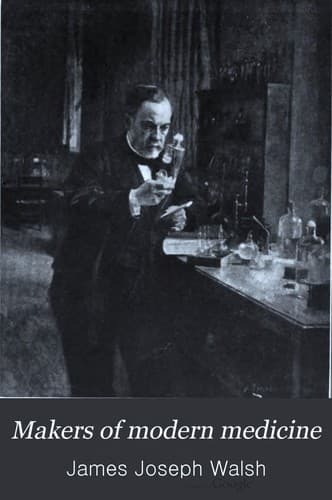
Makers of Modern MedicineWalsh, James J. (James Joseph)
History
Makers of Modern Medicine
Walsh, James J. (James Joseph)
Medicine -- Biography
Vienna.
Even this long list does not include all his various honorary and
active memberships in scientific and medical societies. He was,
besides, the laureate, that is, a prize winner, of the Medical
Faculty of the University of Bonn, of the Sömmering Prize of the
Senkenberg Institution, of the Copley Medal of the Royal Society
of London, of the Culver Prize Monthyon of the same institution,
as well as laureate of the Academy of Sciences of Vienna for
Experimental Physiology. He had been honored by the King of
Prussia by the conferment of the knighthood of the Order of the
Red Eagle, by the King of Sweden by the Royal Swedish Order of the
North Star, by the King of Bavaria by the Royal Bavarian
Maximilian Order, and by the King of Sardinia by a knighthood in
the Order of SS. Mauritius and Lazarus.]
{245}
It is as a teacher that Müller did his best work. He was not by nature
a good talker and never said much, but he was very direct; and, as he
spoke from the largest possible and most progressive knowledge of the
subject, his lectures were always interesting to serious students.
There seems to be a more or less general agreement that for the mass
of his students he was uninteresting because likely to be above their
heads. For the talented members of his class, however, he was an ideal
teacher--always suggestive, always to the point, and eminently
complete. Du Bois-Reymond says that he never was confused, never
repeated himself, and never contradicted himself.
He was able to illustrate his lectures by sketches on the board in a
way that enabled students to follow every step of {246} even a
complex, embryological developmental process. He could trace, step by
step, with the chalk, every stage of evolution in the organism and
bring it clearly before his students. To a narrow circle of the best
men within his class he became a personal friend, whose inspiration
led them on to the deepest original researches. Among his students
were some of the men who made German medicine and German science known
all over the world in the last fifty years. Chief among them may be
mentioned Virchow, Helmholtz, Du Bois-Reymond, Schwann, Lieberkuhn,
the discoverer of the follicles in the intestines; Max Schultze, whose
work in histology and physiology are well known; Claparede, Remak,
Guido, Wagener, Lachmann and Reichert.
Public-domain text, read in full here on John Shaqi.
Reviews
Reviews
No reviews yet
Be the first to share your thoughts on this work.
Elsewhere in the archive
Join the Discussion
Join the discussion
Sign in to leave a comment or review.
Sign InorCreate an account