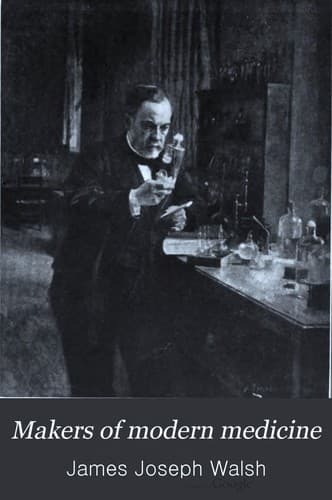
Makers of Modern MedicineWalsh, James J. (James Joseph)
History
Makers of Modern Medicine
Walsh, James J. (James Joseph)
Medicine -- Biography
It is one of the curious features of history that genuine worth of
human accomplishment is almost in inverse ratio to the popularity it
obtains in the generation in which it is produced. Supremely great
work is rarely appreciated at anything like its proper value, by
contemporaries. This principle is true apparently in all fields of
human endeavor. In literature and in art it is a commonplace. But
also, surprising though it may be, in science and in social betterment
the rule holds a prominent place. It is nearly always the sign of only
passing merit when any work secures the plaudits of its own
generation. Brilliant theories are often immediately hailed with
universal acclaim, while ground-breaking observations that are really
great discoveries are apt to be neglected. The really new discovery is
so novel that men cannot appreciate it at once. It is so different
from their ordinary modes of thinking that they cannot place it
properly. Its complete significance fails them.
This has been true for our nineteenth century biology almost more
strikingly than for any other department of knowledge. Our many
avenues of publicity instead of heralding abroad the great
observations as soon as they have been made, in order to enable others
to continue the work that the master mind has begun, have been only
too constantly crowded with new opinions, novel theories, taking
hypotheses, all attracting attention that they did not deserve. Men
like Theodore Schwann, the father of the cell doctrine, are not apt to
be so well known as the suggestor of some {254} striking bit of
theory. Even the great biologists, such as Darwin himself, are known
rather for their insubstantial theories than for their substantial
additions to biological knowledge by patient observation and genial
penetration into the secrets of nature. It is perhaps a warning to the
modern physician who realizes this state of affairs, not to take the
popular theories even in his own branch of biology as the current coin
of truth. Theories pass, but observations endure. Auenbrugger's new
method of tapping the chest in order to elicit its varying sounds
looked even more childish than Galvani's acceptance of the position of
dancing master to a frog, but their observations thus made continued
the germs of undying truth.
While the name and the life of Theodore Schwann are but little known
by the general public, his work is very thoroughly appreciated by
those who have made special studies in biology, and few men in the
progress of that science are considered to hold as high a place as
that assigned to him. A study of the life of Schwann will serve to
show not only that he eminently deserves this honor which has come to
him, but will also bring into evidence the fact that his career
deserves to be better known popularly, because it illustrates very
well the typical mode of life in which great scientists are nurtured
and the methods of investigation by which great discoveries are made.
Public-domain text, read in full here on John Shaqi.
Reviews
Reviews
No reviews yet
Be the first to share your thoughts on this work.
Elsewhere in the archive
Join the Discussion
Join the discussion
Sign in to leave a comment or review.
Sign InorCreate an account