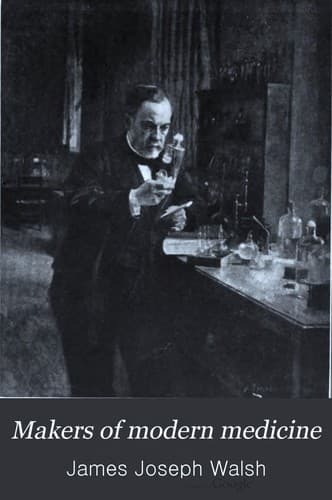
Makers of Modern MedicineWalsh, James J. (James Joseph)
History
Makers of Modern Medicine
Walsh, James J. (James Joseph)
Medicine -- Biography
During his stay at Liège Schwann was formally invited, {267} on three
different occasions, to return to his German Father-land to become
professor at some of her great universities. Professorial chairs in
anatomy or physiology at Würzburg, at Giessen, and at Breslau, were
offered him between 1850 and 1860. He refused them, however, to
continue his work in Belgium. He found his adopted countrymen
eminently sympathetic. It seems clear that he felt more at home in the
midst of the profoundly Catholic sentiment that pervaded the Belgian
universities, and which was in such marked contrast to the
rationalistic spirit characteristic of the German universities at that
time. Schwann was penetrated with a lively sense of the deepest
religious feeling, which is noticeable all through his life. His
attitude in this matter greatly impressed his scientific
contemporaries. His sense of duty in matters spiritual was only
equalled by his affectionate regard for his relatives. His vacations
were invariably spent with his parents while they were alive, and
later with his brothers and sisters in the neighborhood of Cologne. It
was while making a Christmas visit to them that he suffered the fatal
stroke which carried him away.
Toward the end of his career Schwann was invited to be a member of a
commission to investigate the case of Louise Lateau. It will be
remembered that the report of recurring bleedings from stigmata in
this case attracted a great deal of attention, not only among
Catholics, but among all classes throughout the world. After careful
observation Schwann refused to concur in the report that the bleedings
were manifestly miraculous. At first it was announced that he had
declared them evidently beyond the domain of natural causes, but this
report he took occasion to correct immediately. The circumstance led
to the publication of some harsh words in the religious press, but
with his usual moderation Schwann refused to enter into any
discussion, and so the affair ended. {268} His thoroughly conservative
attitude in the matter, and his application of the strictest
scientific criteria to the case, prevented formal expression of
approval on the part of those in authority. While such an opinion
would have carried only personal weight with it, it might easily have
been made a cause for unfortunate aspersions upon the Church.
Public-domain text, read in full here on John Shaqi.
Reviews
Reviews
No reviews yet
Be the first to share your thoughts on this work.
Elsewhere in the archive
Join the Discussion
Join the discussion
Sign in to leave a comment or review.
Sign InorCreate an account