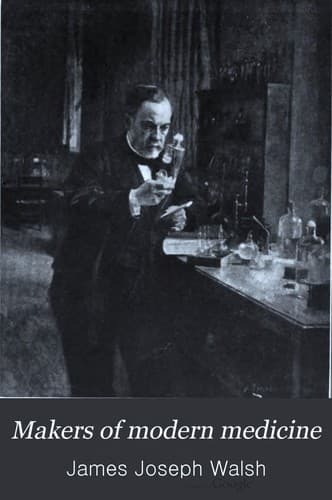
Makers of Modern MedicineWalsh, James J. (James Joseph)
History
Makers of Modern Medicine
Walsh, James J. (James Joseph)
Medicine -- Biography
Bernard was especially interested in anatomy, and soon made himself
known by the perfection of his dissections. Physiology attracted him
not for what was known in the science, but for the many problems as
yet unsolved. His was above all a mind not prone to accept scientific
teaching on the _ipse dixit_ of a professor. Except in the
dissecting-room, his work attracted no attention. He was not looked
upon as a brilliant student, and yet all the while he was
unconsciously preparing himself thoroughly for his life-work. Later on
his dissecting skill was to be a most helpful acquisition. Bernard's
first promising opening came unexpectedly. The nicety with which he
did certain dissecting work in preparation for one of Magendie's
lessons attracted the attention of the professor, at that time the
greatest living experimental physiologist. Magendie, in his bluff,
characteristic way, without asking further about him, called out one
day: "I say, you there, I take you as my _preparateur_ at the Collège
de France."
This position was gladly accepted by Bernard, for it provided him with
an income sufficient to support himself. The work was congenial. His
duty was to prepare the specimens and make ready the demonstrations
for Magendie's lectures. His career as a physiologist dates from this
appointment. He had to give some private lessons, and do what is
called "coaching," or "tutoring," to eke out his slender income, but
in the main his time after this was entirely devoted to investigation
and experiment.
His first investigation concerned stomach digestion. It was important
mainly because it directed his mind to digestive questions. In these
he was to make his great discoveries. {277} His first independent
investigation concerned the differences to be found in the digestive
apparatuses and functions of the carnivora and herbivora--that is, of
the meat and plant-eating animals. The differences in the natural
habits of these two classes of animals had long been noted. While the
meat-eaters invariably bolt their food, the plant-eaters chew theirs
very carefully. Many of these latter, like the cow, are
ruminants--that is, they bring up their food to chew it over again at
their leisure. The instinct that makes them do this is most precious.
Their food is mainly composed of starch, in the digestion of which the
saliva takes a large part. The thorough mixture of the food with
saliva, then, is an extremely important matter. Human beings, who are
both herbivorous and carnivorous, must learn to masticate thoroughly
at least the starch-containing portions of the food. Bernard's first
researches concerned the nerves that supplied the salivary glands, and
which consequently influence the flow of saliva. Curiously enough, the
conclusions of his first experiments were erroneous. The topic led
him, however, into the general subject of the influence of nerves upon
glandular secretion, a problem that he was destined to illustrate in
many ways.
Public-domain text, read in full here on John Shaqi.
Reviews
Reviews
No reviews yet
Be the first to share your thoughts on this work.
Elsewhere in the archive
Join the Discussion
Join the discussion
Sign in to leave a comment or review.
Sign InorCreate an account