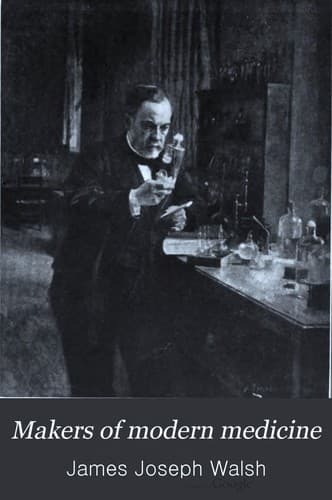
Makers of Modern MedicineWalsh, James J. (James Joseph)
History
Makers of Modern Medicine
Walsh, James J. (James Joseph)
Medicine -- Biography
Bernard's attention was directed by this first observation to the
other properties of the pancreatic fluid. He soon demonstrated by
experiment, not only that it split up fats into fatty acids and
glycerin, and so made their absorption possible, but that it had a
powerful action upon proteids--that is, upon the albuminous portions
of the food, and also upon the starches and sugars. Up to this time
the principal role in digestion had been assigned to the stomach and
the gastric juice. After Bernard's observations it was evident that
the action of the stomach was mainly preliminary to intestinal
digestion, and that the chief work in the preparation of food for
absorption into the system was really accomplished by the secretion of
the pancreas. It took some years to make all this clear. Much of the
advance in our knowledge of the effect of pancreatic juice upon
proteids--that is, upon meat and other albuminous materials--is due to
Kühne, a pupil {279} of Bernard; but not only did the inspiration for
the pupil's work come from the master, but the important fundamental
principle of pancreatic proteolysis--_i.e._, the solution of proteids
by pancreatic secretion--was clearly laid down in Bernard's original
publications on the subject. Only in our own day has come the greatest
confirmation of the notion then first introduced into physiology, of
the surpassing importance of intestinal digestion. The removal of the
whole stomach for malignant disease is now undertaken without any
fears as to the ultimate result on the patient's general nutrition.
The operation has been done many times, and the surgeon's confidence
that the intestines would compensate, as far as digestion of food was
concerned, for the absent stomach has been amply justified. Patients
who survived the operation have all gained in weight, and some of them
have enjoyed better health than for years before the removal of their
stomachs.
From his studies of the pancreas, Bernard, whose mind was always of a
very practical bent, was very naturally led to the study of that
puzzling disease, diabetes. The question of how sugar was absorbed
into the system was an interesting one even at that time. It was not
realized, as it is now, that saccharine material was a most valuable
food-stuff. Its use in the world's great armies of recent years has
brought sugar very prominently before the medical profession of
to-day. The bone and sinew for hard fighting and exhausting marches
would not seem to be derivable from the favorite dainty of the child,
which has besides fallen into such disrepute as a health disturber;
yet tons upon tons of sweets are now shipped to fighting armies, and
are distributed in their rations when especially hard work is required
of them. Bernard did not quite realize that he was attacking, in the
question of the digestion and consumption of sugar in the system, one
of the {280} most important problems of nutrition, especially as far
as regards the production of heat.
Public-domain text, read in full here on John Shaqi.
Reviews
Reviews
No reviews yet
Be the first to share your thoughts on this work.
Elsewhere in the archive
Join the Discussion
Join the discussion
Sign in to leave a comment or review.
Sign InorCreate an account