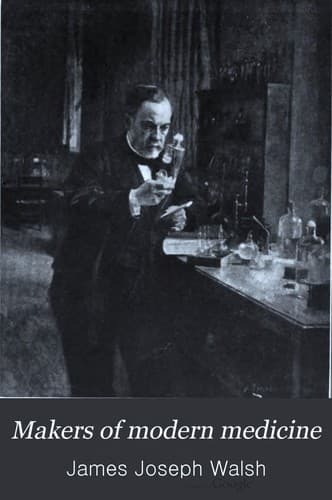
Makers of Modern MedicineWalsh, James J. (James Joseph)
History
Makers of Modern Medicine
Walsh, James J. (James Joseph)
Medicine -- Biography
His studies on sugar logically led Bernard to the investigation of
heat production and heat regulation in the human body. Glycogen, the
sugary substance produced by the liver, occurs abundantly in all the
muscles of the body, and it was evident that muscular movement leads
to its consumption and the consequent production of heat. Sugar is a
carbon-containing substance, and its combustion always produces
energy. The question of heat regulation was a much more complicated
problem. Heat is always being produced in the human body and always
being given off. Very different amounts of heat are required to keep
up the temperature of the human body in the winter and summer seasons.
Near the pole or at the equator man's temperature in health is always
the same. To secure this identity of temperature some very delicately
balanced mechanism is required. Without the most nicely adjusted
equilibrium of heat production and dissemination human tissues would
soon freeze up at a {282} temperature of 70° below zero, or the
albumin of the body fluids and muscular tissue coagulate at a
temperature above 110° F.
While engaged in the investigation of this interesting problem Claude
Bernard found that the cutting of the sympathetic nerves in the neck
of a rabbit was followed by increased heat on the side of the head
supplied by the nerve, and that this increased heat coincided with
heightened sensibility and greater blood-supply in the parts affected.
Here was an important factor in heat regulation laid bare. It was
evident that the sympathetic nerve trunk supplied filaments to the
small arteries, and that when these nerves no longer acted, as after
the cutting of the nerve trunk, these arteries were no longer
controlled by the nervous system and became dilated. The presence of
more blood than usual in the tissues and its slower flow gave occasion
to more chemical changes in the part than before, and consequently to
the production of more heat.
Public-domain text, read in full here on John Shaqi.
Reviews
Reviews
No reviews yet
Be the first to share your thoughts on this work.
Elsewhere in the archive
Join the Discussion
Join the discussion
Sign in to leave a comment or review.
Sign InorCreate an account