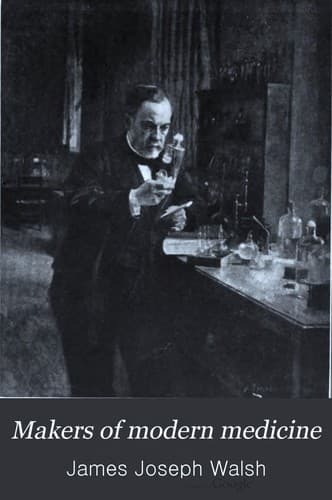
Makers of Modern MedicineWalsh, James J. (James Joseph)
History
Makers of Modern Medicine
Walsh, James J. (James Joseph)
Medicine -- Biography
These two discoveries by Bernard--the formation of sugar by the liver
and the nervous vasomotor mechanism--are, in their far-reaching
application and their precious suggestiveness for other investigators,
the most significant advances in physiology of the nineteenth century.
They are directly due to a great imaginative faculty informing a most
fertile inquiring spirit. Bernard was very different from his master,
Magendie, in his applications of the experimental method. Magendie's
researches were made more or less at random in the great undiscovered
regions of physiology. He made his experiments as so many questions of
nature. He cared not what the answer might be. He seldom had an
inkling beforehand where his experiments might carry him. As he said
himself, he was a rag-picker by the dust-heap of science, hoping to
glean where others had missed treasures, and not knowing what his
stick might turn up next. Bernard's experiments were always made with
a definite idea as to what he sought. Not infrequently his
pre-conceived theory proved to be a mistake. It is of the very {284}
genius of the man that he was able to recognize such errors, and that
he did not attempt to divert the results of experiments so as to
bolster up what looked like eminently rational theories. The
imaginative faculty that had come so near perverting him to literature
was a precious source of inspiration and initiative in his scientific
work. It was not followed as an infallible guide, however, but only as
a suggestive director of the course investigation should take.
Besides the important discoveries made by Bernard there are two minor
investigations, successfully accomplished, that deserve a passing
word. To Claude Bernard we owe the use of curare in physiological
experimentation. Curare is an Indian arrow poison which absolutely
prevents all muscular movement. If artificial respiration is kept up,
however, the animal lives on indefinitely, and no motion will disturb
the progress of the most delicate experiment. In Bernard's time it was
thought that the drug did not affect the sensory nervous system at
all, and that as a consequence, though absolutely immobile, the animal
might be suffering the most excruciating pain. We now know that the
sensory system is also affected, and that the animal in these
experiments suffers little if at all.
Public-domain text, read in full here on John Shaqi.
Reviews
Reviews
No reviews yet
Be the first to share your thoughts on this work.
Elsewhere in the archive
Join the Discussion
Join the discussion
Sign in to leave a comment or review.
Sign InorCreate an account