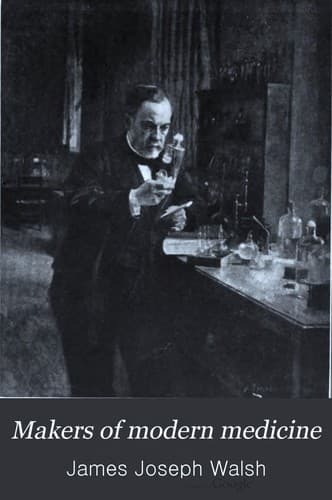
Makers of Modern MedicineWalsh, James J. (James Joseph)
History
Makers of Modern Medicine
Walsh, James J. (James Joseph)
Medicine -- Biography
This raising of his thoughts far above the sordid realities he is
concerned with into the realms of suggestive theory is typical of
Pasteur. His was a true creative mind--poetic {304} in its highest
sense. The imagination properly controlled is of as great value to the
scientist as to the poet. Pasteur's theories were ever pregnant with
truth to be. All his life he kept this question of dissymmetry before
his mind and hoped to get back to work at it. But opportunity failed.
Other and more practical work was destined to occupy the busy
half-century of investigation that followed.
Most of Pasteur's work, after this first thrilling discovery and its
possible significance, is very well known. His meditations on the
distinction between material derived from living and non-living
sources led him to investigate certain processes called
fermentations--before his time considered merely chemical. It is well
known that if a dilute solution of sugar be exposed to the air
anywhere in the world it will ferment--that is, certain changes will
take place in the liquid, some gas will escape from its surface and
alcohol will be formed. There are changes that take place in other
organic substances--milk, meat solutions, butter, etc.--that resemble
quite closely alcoholic fermentations, though the end-product of the
process is not alcohol. Pasteur showed that all these supposed
chemical changes are really due to the presence of minute living
cells, called ferments. During the growth of these cells they split up
the substances contained in the material in which they occur, using
parts of them for their nutrition. He proved this very clearly for the
lactic acid and butyric acid fermentations. Milk was supposed to
become sour and butter rancid because they are unstable organic
compounds, liable to change in the presence of the oxygen of the air.
These changes were now shown to be due to minute living things that
grow in the milk and the butter.
Public-domain text, read in full here on John Shaqi.
Reviews
Reviews
No reviews yet
Be the first to share your thoughts on this work.
Elsewhere in the archive
Join the Discussion
Join the discussion
Sign in to leave a comment or review.
Sign InorCreate an account