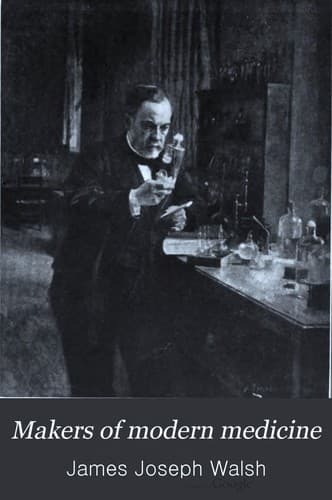
Makers of Modern MedicineWalsh, James J. (James Joseph)
History
Makers of Modern Medicine
Walsh, James J. (James Joseph)
Medicine -- Biography
His attention was next naturally directed to the diseases of animals
and human beings. His studies in fermentations and in silkworm
diseases had taught him the use of the microscope for such
investigations. Splenic fever--known also as anthrax--a disease that
attacks most species of domestic animals and may also prove fatal to
man, was the first to yield the secret of its origin. The cause proved
to be a bacterium--that is, a small, rod-shaped plant. This was but
the first of a series of similar discoveries, until now the science of
bacteriology has become one of the most important branches of
knowledge. Pasteur's investigations included much more, however, than
the mere discovery of the germ of the disease. He showed that a series
of diseases which passed under different names in different animals
were all due to the same cause. Further, he discovered one of the
methods of distributing the disease. When the carcasses of animals
that have died from the disease are not buried deeply below the
surface of the ground, animals grazing above may become infected with
the disease. {309} The germs of the disease can be shown to occur in
the grass above the graves. It is carried to the surface in the bodies
of earth-worms. This important observation was the first hint of the
methods of disease distribution by some living intermediary. Modern
medicine has come to understand that these biological distributing
agents are far more important than the fabled transmission through the
air.
Pasteur overturned the notion of spontaneous generation of life. Then
his work eradicated the idea of the spontaneous generation of disease.
It opened up a new era by showing that the origin of many diseases is
not due to changes in the atmosphere nor to some morbid productivity
of soil or water under favoring circumstances, but to minute living
organisms whose multiplication is encouraged by the conditions that
were supposed to produce disease. Finally, came the precious
suggestion that living things always convey and distribute disease;
man to man, for epidemics travel not with the velocity of the wind but
only as fast as the means of communication between distant points;
animal to man, as is well known, for many diseases now; and, lastly,
insects, worms and the like were also shown to be real carriers of
disease.
Public-domain text, read in full here on John Shaqi.
Reviews
Reviews
No reviews yet
Be the first to share your thoughts on this work.
Elsewhere in the archive
Join the Discussion
Join the discussion
Sign in to leave a comment or review.
Sign InorCreate an account