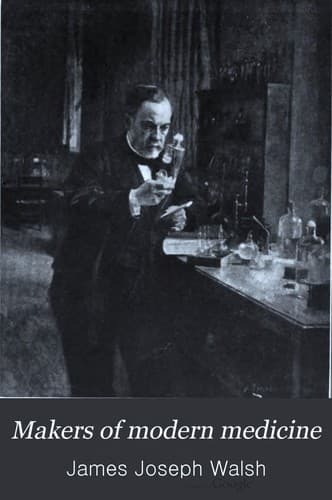
Makers of Modern MedicineWalsh, James J. (James Joseph)
History
Makers of Modern Medicine
Walsh, James J. (James Joseph)
Medicine -- Biography
When Pasteur recovered sufficiently to resume work, it was soon clear
to apprehensive friends that he had no intention of leaving his ideas
to be worked out by other men. The miseries of the Franco-Prussian War
deeply affected him, and could not fail to inhibit his productiveness,
but after a time the unquenchable love for experimental research was
once more ascendant and there began a new epoch, the epoch of great
discoveries relating to the origin and cure or prevention of the
infectious diseases of man and the domestic animals. As in the case of
Ignatius Loyola, it seems as if the lamp of the genius shone with a
larger and more luminous flame after the onset of bodily infirmity in
defiance of the physical mechanism which is too often permitted to
master the will.
After his illness Pasteur devoted himself even more than before to the
study of the various biological problems connected with human
diseases. There was one exception to this, in his series of studies on
beer, undertaken shortly after {313} the Franco-Prussian War. Pasteur
was an ardent patriot, so much so, indeed, that after the war he sent
back to the German government certain decorations and diplomas that
had been conferred upon him. He thought that his country had been
overreached by a scheming, political statesman, bent on the
aggrandizement of the kingdom of Prussia. To the end of his life this
feeling of hostility never entirely vanished. It was his hope, then,
that by improving the character of French beer it might not only be
made more wholesome in the best sense of the word, but also that the
French brewing industry might be made a serious rival of its German
competitors. Pasteur's discoveries are the most important for the
brewing industry that have ever been made. The Germans proved,
however, even more capable of taking advantage of them than his French
compatriots.
After this Pasteur devoted himself without further interruption to the
study of the microbic diseases of man. His greatest practical triumph
was undoubtedly with regard to hydrophobia, or, as it is more properly
called, rabies. The mystery of the disease was most illusive. Pasteur
could not succeed in finding the germ of the disease. Even down to our
own day it has not been satisfactorily demonstrated. In spite of this
lack of an important element of knowledge, which might be supposed
absolutely essential for the successful therapeutics of rabies from a
biological standpoint, Pasteur succeeded in producing material that
would protect those bitten by rabid dogs from developing the affection.
Public-domain text, read in full here on John Shaqi.
Reviews
Reviews
No reviews yet
Be the first to share your thoughts on this work.
Elsewhere in the archive
Join the Discussion
Join the discussion
Sign in to leave a comment or review.
Sign InorCreate an account