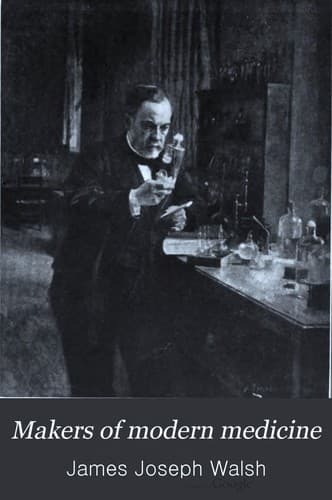
Makers of Modern MedicineWalsh, James J. (James Joseph)
History
Makers of Modern Medicine
Walsh, James J. (James Joseph)
Medicine -- Biography
All united in honoring the marvellous genius whose work has proved of
such practical utility for mankind, and whose discoveries are as yet
only beginning their career of pregnant suggestiveness to scientific
men. His genius has brought the great ones of earth to his level or
raised him to theirs. His own thought on the equality of man is a
confession of the faith that was in him. It was expressed in his
discourse of reception into the French Academy in the midst of the
panegyric on Littré, from which we quoted at the beginning of this
sketch: "Where are the true sources of human dignity, of liberty and
of modern democracy, if not in the infinite, before which all men are
equal? The notion of the infinite finds everywhere its inevitable
expression. By it the supernatural is at the bottom of every heart."
Pasteur, the man, is, however, if possible, even more interesting than
Pasteur, the greatest of living scientists. In the midst of all his
work and his wonderful success, amid the plaudits of the world,
Pasteur remained one of the simplest of men and the kindest of friends
to those who knew him. Dr. Roux's expression is well known: "The work
of Pasteur is admirable; it shows his genius; but one must have lived
on terms of intimacy with him in order to know all the goodness of his
heart." He was kindness personified, and those who think of him as a
cruel vivisector and encourager of experiments upon animals that cause
suffering, belie him and his humanity very much. He would never permit
animals to be used in experiments without an anesthetic, and even then
only when he deemed that use absolutely necessary for the furtherance
of projects that promised great benefit to humanity. Nothing was
harder for him to do than to walk the hospitals and see human
suffering when he was studying the causes of disease in human beings.
Even the slight pain inflicted during the {317} injections for
hydrophobia was a source of great discomfort to him, and his anxiety
with regard to these patients was one of the main causes of the
breakdown in health that shortened his life.
One of the most beautiful things about Pasteur's personal life is the
relation to his family, and especially to his children, and their
union in religious simplicity. On the occasion of the death of his
father, whom Pasteur loved very deeply and for whom he had instilled
the deepest affection into the hearts of his children, he wrote to his
daughter, whose first communion was to occur on that day. His letter
is that of a man deeply affectionate, sincerely religious, and
eminently trustful of the future that faith alone points out. His
letter runs:
Public-domain text, read in full here on John Shaqi.
Reviews
Reviews
No reviews yet
Be the first to share your thoughts on this work.
Elsewhere in the archive
Join the Discussion
Join the discussion
Sign in to leave a comment or review.
Sign InorCreate an account