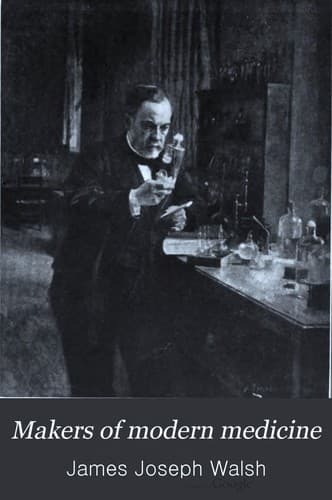
Makers of Modern MedicineWalsh, James J. (James Joseph)
History
Makers of Modern Medicine
Walsh, James J. (James Joseph)
Medicine -- Biography
For Pasteur, death had no mysteries. He had written to his father,
once, on the death of his little daughter Jeanne: "I can only think at
this moment of my poor little one so good, so full of life, so happy
in living, and whom this fatal year, now drawing to a close, has
snatched from us. After a very short time she would have been for her
mother and for me, for all of us, a friend, a companion, a helpmate.
But I ask your pardon, dear father, for recalling to you such sad
memories. She is happy. Let us think of those who remain, and let us
try to prevent for them, as far as lies in our power, the bitternesses
of life." So, when it came to the hour of his own death, Pasteur faced
it with the simple confidence of a sincere Christian, and the
undoubting faith of a lifelong son of the Church. For many hours he
remained motionless, one of his hands resting in that of Madame
Pasteur, while the other held a crucifix. His last conscious glance
was for his lifelong companion, his last conscious act a pressure of
the image of his Redeemer. Thus, surrounded by his family and
disciples in a room of almost monastic simplicity, on Saturday,
September 28, 1895, about five in the afternoon, passed peacefully
away the greatest of the nineteenth century scientists.
{319}
Almost needless to say, the life of a man like Pasteur contains the
most wonderful lessons for the young scientists of the twentieth
century. Few men have lived their lives so unselfishly, and with so
much preoccupation for the good that they might accomplish, as he did.
To have remained in the midst of it all simple, earnest and faithful
to duty, without self-seeking, is a triumph worthy of recording, and
makes a career well deserving of emulation. When Pasteur made his
discoveries with regard to fermentation the Empress of the French
asked to be shown just what his investigations had demonstrated.
Pasteur went to Court for the purpose, and after the Emperor and
Empress had been shown the ferment cells, and expressed their
interest, Eugenie said: "Now, you will develop this discovery
industrially, will you not?" Pasteur replied. "Ah, no, that will be
left for others. It does not seem to me that it would be worthy of a
French scientist to allow himself to be diverted to the industrial
applications of his discoveries, even though it might prove eminently
lucrative for him." As a matter of fact, had Pasteur allowed himself
to be allured into the foundation of an immense manufactory
constructed and directed on the great principles which he had
discovered, there seems no doubt that this would have been a wonderful
money-making scheme. Certain it is that the capital for such an
adventure would have been readily available. Had Pasteur yielded to
the solicitations made him he might have died worth many millions,
instead of the very modest competency which came to him in the
ordinary course of his scientific labors. The money might have seemed
Public-domain text, read in full here on John Shaqi.
Reviews
Reviews
No reviews yet
Be the first to share your thoughts on this work.
Elsewhere in the archive
Join the Discussion
Join the discussion
Sign in to leave a comment or review.
Sign InorCreate an account