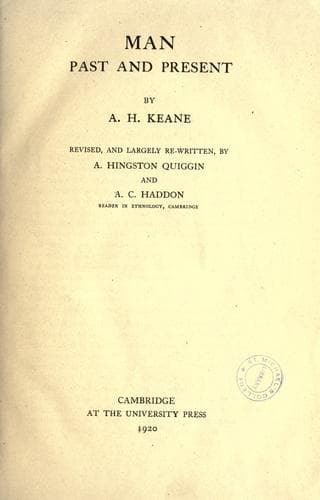
Man, Past and PresentKeane, A. H. (Augustus Henry)
History
Man, Past and Present
Keane, A. H. (Augustus Henry)
Anthropology; Ethnology
It is probable that at some remote period the ruling race reached the
west coast from the north-east, and imposed their Bantu speech on the
rude aborigines, by whom it is still spoken over a wide tract of country
on both sides of the Lower Congo. It is an extremely pure and somewhat
archaic member of the Bantu family, and W. Holman Bentley, our best
authority on the subject, is enthusiastic in praise of its "richness,
flexibility, exactness, subtlety of idea, and nicety of expression," a
language superior to the people themselves, "illiterate folk with an
elaborate and regular grammatical system of speech of such subtlety and
exactness of idea that its daily use is in itself an education[272]."
Kishi-Kongo has the distinction of being the first Bantu tongue ever
reduced to written form, the oldest known work in the language being a
treatise on Christian Doctrine published in Lisbon in 1624. Since that
time the speech of the "Mociconghi," as Pigafetta calls them[273], has
undergone but slight phonetic or other change, which is all the more
surprising when we consider the rudeness of the present Mushi-Kongos and
others by whom it is still spoken with considerable uniformity. Some of
these believe themselves sprung from trees, as if they had still
reminiscences of the arboreal habits of a pithecoid ancestry.
Amongst the neighbouring _Ba-Mba_, whose sobas were formerly _ex
officio_ Commanders-in-chief of the Empire, still dwells a potent being,
who is invisible to everybody, and although mortal never dies, or at
least after each dissolution springs again into life from his remains
gathered up by the priests. All the young men of the tribe undergo a
similar transformation, being thrown into a death-like trance by the
magic arts of the medicine-man, and then resuscitated after three days.
The power of causing the cataleptic sleep is said really to exist, and
these strange rites, unknown elsewhere, are probably to be connected
with the resurrection of Christ after three days and of everybody on the
last day as preached by the early Portuguese evangelists. A volume might
be written on the strange distortions of Christian doctrines amongst
savage peoples unable to grasp their true inwardness.
Public-domain text, read in full here on John Shaqi.
Reviews
Reviews
No reviews yet
Be the first to share your thoughts on this work.
Elsewhere in the archive
Join the Discussion
Join the discussion
Sign in to leave a comment or review.
Sign InorCreate an account