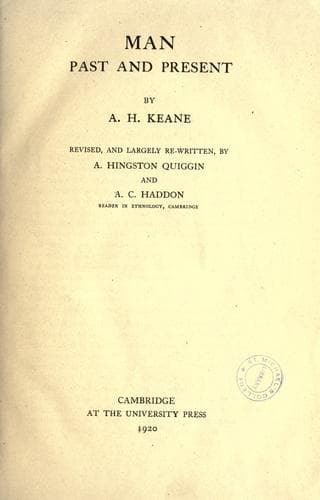
Man, Past and PresentKeane, A. H. (Augustus Henry)
History
Man, Past and Present
Keane, A. H. (Augustus Henry)
Anthropology; Ethnology
It would therefore seem probable that the Munkulunkulu peoples from the
north-east gradually spread by the indicated routes over the whole of
Bantuland, everywhere imposing their speech, general culture, and
ancestor-worship on the pre-Bantu aborigines, except along the Atlantic
coastlands and in parts of the interior. Here the primitive
Nature-worship, embodied in Nzambi, held and still holds its ground,
both meeting on equal terms--as shown in the above table--amongst the
Ba-Yanzi, the Ova-Herero, and the Be-Chuanas (_Mulungulu_ generally, but
_Nyampe_ in Barotseland), and no doubt in other inland regions. But the
absolute supremacy of one on the east, and of the other on the west,
side of the continent, seems conclusive as to the general streams of
migration, while the amazing uniformity of nomenclature is but another
illustration of the almost incredible persistence of Bantu speech
amongst these multitudinous illiterate populations for an incalculable
period of time[291].
THE VAALPENS AND THE STRANDLOOPERS.
Among the ethnological problems of Africa may be reckoned the _Vaalpens_
and the _Strandloopers_. Along the banks of the Limpopo between the
Transvaal and Southern Rhodesia there are scattered a few small groups
of an extremely primitive people who are generally confounded with the
Bushmen, but differ in some important respects from that race. They are
the "Earthmen" of some writers, but their real name is _Kattea_, though
called by their neighbours either _Ma Sarwa_ ("Bad People") or
_Vaalpens_ ("Grey Paunches") from the khaki colour acquired by their
bodies from creeping on all fours into their underground hovels. But the
true colour is almost a pitch black, and as they are only about four
feet high they are quite distinct both from the tall Bantus and the
yellowish Hottentot-Bushmen. For the Zulus they are mere "dogs" or
"vultures," and are certainly the most degraded of all the aborigines,
being undoubtedly cannibals, eating their own aged and infirm like some
of the Amazonian tribes. Their habitations are holes in the ground,
rock-shelters, or caves, or lately a few hovels of mud and foliage at
the foot of the hills. Of their speech nothing is known except that it
is absolutely distinct both from the Bantu and the Bushman. There are no
arts or industries of any kind, not even any weapons beyond those
procured in exchange for ostrich feathers, skins or ivory. But they can
make fire, and are thus able to cook the offal thrown to them by the
Boers in return for their help in skinning the captured game. Whether
they have any religious ideas it is impossible to say, all intercourse
with the surrounding peoples being restricted to barter carried on with
gesture language for nobody has ever yet mastered their tongue. A
"chief" is spoken of, but he is merely a headman who presides over the
little family groups of from thirty to fifty (there are no tribes
properly so called), and whose purely domestic functions are acquired,
Public-domain text, read in full here on John Shaqi.
Reviews
Reviews
No reviews yet
Be the first to share your thoughts on this work.
Elsewhere in the archive
Join the Discussion
Join the discussion
Sign in to leave a comment or review.
Sign InorCreate an account