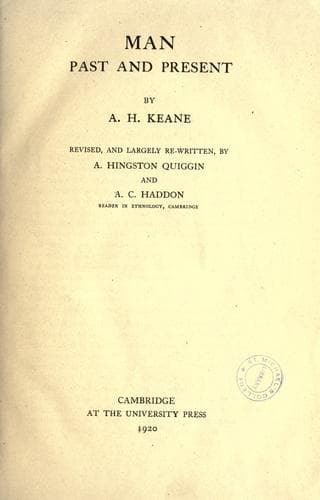
Man, Past and PresentKeane, A. H. (Augustus Henry)
History
Man, Past and Present
Keane, A. H. (Augustus Henry)
Anthropology; Ethnology
#Papuasian#: 1. Western Papuasians (_true Papuans_): _nearly all the New
Guinea natives_; _Aru and other insular groups thence westwards to
Flores_; _Torres Straits and Louisiade Islands_. 2. Eastern Papuasians:
_nearly all the natives of Melanesia from Bismarck Archipelago to New
Caledonia, with most of Fiji, and part of New Guinea_.
#Negritoes#: 1. Andamanese _Islanders_. 2. Semangs, _in the Malay
Peninsula_. 3. Aetas, _surviving in most of the Philippine Islands_. 4.
_Pygmies in New Guinea._
* * * * *
PAPUASIANS.
From the data supplied in _Ethnology_, Chap. XI. a reconstruction may be
attempted of the obscure ethnical relations in Australasia on the
following broad lines.
1. The two main sections of the Ulotrichous division of mankind, now
separated by the intervening waters of the Indian Ocean, are
fundamentally one.
2. To the Sudanese and Bantu sub-sections in Africa correspond, _mutatis
mutandis_, the Papuan and Melanesian sub-sections in Oceania, the former
being distinguished by great linguistic diversity, the latter by
considerable linguistic uniformity, and both by a rather wide range of
physical variety within certain well-marked limits.
3. In Africa the physical varieties are due mainly to Semitic and
Hamitic grafts on the Negro stock; in Oceania mainly to Mongoloid
(Malay) and Caucasian (Indonesian) grafts on the Papuan stock.
4. The Negrillo element in Africa has its counterpart in an analogous
Negrito element in Oceania (Andamanese, Semangs, Aetas, etc.).
5. In both regions the linguistic diversity apparently presents similar
features--a large number of languages differing profoundly in their
grammatical structure and vocabularies, but all belonging to the same
agglutinative order of speech, and also more or less to the same
phonetic system.
6. In both regions the linguistic uniformity is generally confined to
one or two geographical areas, Bantuland in Africa and Melanesia in
Oceania.
7. In Bantuland the linguistic system shows but faint if any
resemblances to any other known tongues, whereas the Melanesian group is
but one branch, though the most archaic, of the vast Austronesian
Family, diffused over the Indian and Pacific Oceans. The Papuan
languages are entirely distinct from the Melanesian. They are in some
respects similar to the Australian, but their exact positions are not
yet proved[319].
8. Owing to their linguistic, geographical, and to some extent their
physical and social differences, it is desirable to treat the Papuans
and Melanesians as two distinct though closely related sub-groups, and
to restrict the use of the terms PAPUAN and MELANESIAN accordingly,
while both may be conveniently comprised under the general or collective
term PAPUASIAN[320].
Public-domain text, read in full here on John Shaqi.
Reviews
Reviews
No reviews yet
Be the first to share your thoughts on this work.
Elsewhere in the archive
Join the Discussion
Join the discussion
Sign in to leave a comment or review.
Sign InorCreate an account