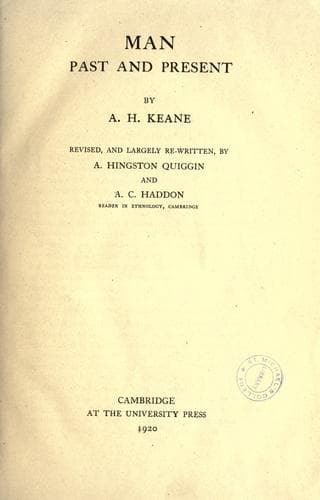
Man, Past and PresentKeane, A. H. (Augustus Henry)
History
Man, Past and Present
Keane, A. H. (Augustus Henry)
Anthropology; Ethnology
The Melanesians are as variable as the natives of New Guinea; the hair
may be curly, or even wavy, showing evidence of racial mixture, and the
skin is chocolate or occasionally copper-coloured. The stature of the
men ranges from 1.50 m. to 1.78 m. (4 ft. 11 in. to 5 ft. 10 in.), with
an average between 1.56 m. and 1.6 m. (5 ft. 1-1/2 in. to 5 ft. 3 in.).
The skull is usually dolichocephalic, but ranges from 67 to 85 and in
certain parts brachycephaly is predominant; the nose shows great
diversity. This type ranges with local variations from the Admiralty
Islands and parts of New Guinea through the Bismarck Archipelago,
Solomon Islands, and the New Hebrides and other island groups to Fiji
and New Caledonia.
The "Kanakas," as the natives of New Caledonia and the Loyalty group are
wrongly[324] called by their present rulers, have been described by
various French investigators. Among the best accounts of them is that of
M. Augustin Bernard[325], based on the observations of de Rochas,
Bourgard, Vieillard, Bertillon, Meinicke, and others. Apart from several
sporadic Polynesian groups in the Loyalties[326], all are typical
Melanesians, long-headed with very broad face at least in the middle,
narrow boat-shaped skull (ceph. index 70)[327], large, massive lower
jaw, often with two supplementary molars[328], colour a dark chocolate,
often with a highly characteristic purple tinge; but de Rochas'
statement that for a few days after birth infants are of a light reddish
yellow hue lacks confirmation; hair less woolly but much longer than the
Negro; beard also longish and frizzly, the peppercorn tufts with
simulated bald spaces being an effect due to the assiduous use of the
comb; very prominent superciliary arches and thick eyebrows, whence
their somewhat furtive look; mean height 5 ft. 4 in.; speech Melanesian
with three marked varieties, that of the south-eastern districts being
considered the most rudimentary member of the whole Melanesian
group[329].
From the state of their industries, in some respects the rudest, in
others amongst the most advanced in Melanesia, it may be inferred that
after their arrival the New Caledonians, like the Tasmanians, the
Andamanese, and some other insular groups, remained for long ages almost
completely secluded from the rest of the world. Owing to the poverty of
the soil the struggle for food must always have been severe. Hence the
most jealously guarded privileges of the chiefs were associated with
questions of diet, while the paradise of the dead was a region where
they had abundance of food and could gorge on yams.
Public-domain text, read in full here on John Shaqi.
Reviews
Reviews
No reviews yet
Be the first to share your thoughts on this work.
Elsewhere in the archive
Join the Discussion
Join the discussion
Sign in to leave a comment or review.
Sign InorCreate an account