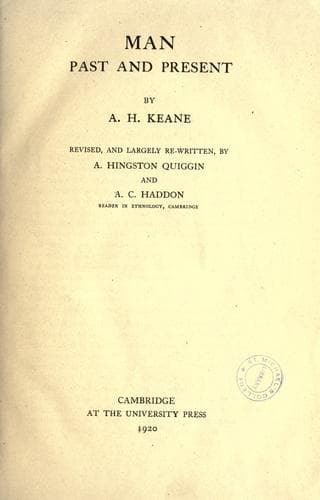
Man, Past and PresentKeane, A. H. (Augustus Henry)
History
Man, Past and Present
Keane, A. H. (Augustus Henry)
Anthropology; Ethnology
The first serious attempt to disentangle the complex character of
Melanesian ethnography was made by F. Graebner in 1905[333], followed by
G. Friederici, the references to whose work are given above. More
recently W. H. R. Rivers[334] has attacked the cultural problem by means
of the genealogical method and the results of his investigations are
here briefly summarised. He has discovered several remarkable forms of
marriage in Melanesia and has deduced others which have existed
previously. He argues that the anomalous forms of marriage imply a
former dual organisation (_i.e._ a division of the community into two
exogamous groups) with matrilineal descent, and he is driven to assume
that in early times there was a state of society in which the elders had
acquired so predominant a position that they were able to monopolise all
the young women. Some of the relationship systems are of great
antiquity, and it is evident that changes have taken place due to
cultural influences coming in from without.
The distribution of kava-drinking and betel-chewing is of great
interest. The former occurs all over Polynesia (except Easter Island and
New Zealand) and throughout southern Melanesia, including certain Santa
Cruz Islands, where it is limited to religious ceremonial. Betel-chewing
begins at these islands and extends northwards through New Guinea and
Indonesia to India. Kava and betel were introduced into Melanesia by
different cultural migrations.
The introduction of betel-chewing was relatively late and restricted and
may have taken place from Indonesia after the invasion by the Hindus.
With it were associated strongly established patrilineal institutions,
marriage with a wife of a father's brother, the special sanctity of the
skull and the plank-built canoe. The use of pile dwellings is a more
constant element of the betel-culture than of the kava-culture. The
religious ritual centres round the skulls of ancestors and relatives,
and the cult of the skull has taken a direction which gives the heads of
enemies an importance equal to that of relatives, hence head-hunting has
become the chief object of warfare. The skull of a relative is the
symbol--if not the actual abiding place--of the dead, to be honoured and
propitiated, while the skulls of enemies act as the means whereby this
honour and propitiation are effected.
Public-domain text, read in full here on John Shaqi.
Reviews
Reviews
No reviews yet
Be the first to share your thoughts on this work.
Elsewhere in the archive
Join the Discussion
Join the discussion
Sign in to leave a comment or review.
Sign InorCreate an account