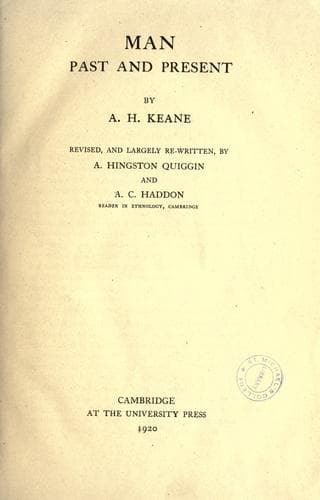
Man, Past and PresentKeane, A. H. (Augustus Henry)
History
Man, Past and Present
Keane, A. H. (Augustus Henry)
Anthropology; Ethnology
In physical features they in many respects resemble the Andamanese.
Their hair is short, universally woolly and black, the skin colour dark
chocolate brown approximating to glossy black[349], sometimes with a
reddish tinge[350]. There is very little evidence for the stature but
the 17 males measured by Annandale and Robinson[351] averaged 1.52 m. (5
ft. 0-1/4 in.). The average cephalic index is about 78 to 79, extremes
ranging from 74 to 84. The face is round, the forehead rounded, narrow
and projecting, or as it were "swollen." The nose is short and
flattened, with remarkable breadth and distended nostrils. The nasal
index of five adult males was 101.2[352]. The cheekbones are broad and
the jaws often protrude slightly; the lips are as a rule thick. Martin
remarks that characteristic both of Semang and Sakai[353] is the great
thickening of the integumental part of the upper lip, the whole mouth
region projecting from the lower edge of the nose. This convexity occurs
in 79 per cent., and is well shown in his photographs[354].
Hugh Clifford, who has been intimately associated with the "Orang-utan"
(Wild-men) as the Malays often call them, describes those of the Plus
River valley as "like African Negroes seen through the reverse end of a
field-glass. They are sooty-black in colour; their hair is short and
woolly, clinging to the scalp in little crisp curls; their noses are
flat, their lips protrude, and their features are those of the pure
negroid type. They are sturdily built and well set upon their legs, but
in stature little better than dwarfs. They live by hunting, and have no
permanent dwellings, camping in little family groups wherever, for the
moment, game is most plentiful[355]."
Their shelters--huts they cannot be called--are exactly like the
frailest of the Andamanese, mere lean-to's of matted palm-leaves crazily
propped on rough uprights; clothes they have next to none, and their
food is chiefly yams and other jungle roots, fish from the stream, and
sun-dried monkey, venison and other game, this term having an elastic
meaning. Salt, being rarely obtainable, is a great luxury, as amongst
almost all wild tribes. They are a nomadic people living by collecting
and hunting; the wilder ones will often not remain longer than three
days in one place. Very few have taken to agriculture. They make use of
bamboo rafts for drifting down stream but have no canoes. All men are on
an equal footing, but each tribe has a head, who exercises authority.
Division of labour is fairly even between men and women. The men hunt,
and the women build the shelters and cook the food. They are strictly
monogamous and faithful.
Public-domain text, read in full here on John Shaqi.
Reviews
Reviews
No reviews yet
Be the first to share your thoughts on this work.
Elsewhere in the archive
Join the Discussion
Join the discussion
Sign in to leave a comment or review.
Sign InorCreate an account