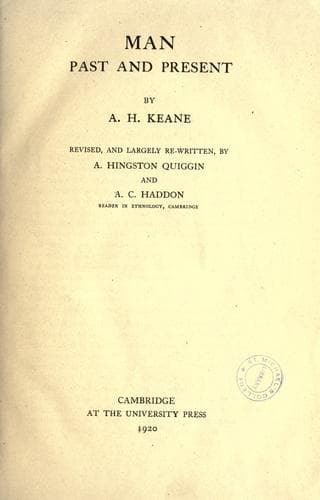
Man, Past and PresentKeane, A. H. (Augustus Henry)
History
Man, Past and Present
Keane, A. H. (Augustus Henry)
Anthropology; Ethnology
At first sight it may seem unaccountable that a race of such extremely
low intellect should be able to assert their supremacy in this way over
the intruding Malayans, assumed to be so much their superiors in
physical and mental qualities. But it has to be considered that the
invasions took place in very remote times, ages before the appearance on
the scene of the semi-civilised Muhammadan Malays of history. Whether of
Indonesian or of what is called "Malay" stock, the intruders were rude
Oceanic peoples, who in the prehistoric period, prior to the spread of
civilising Hindu or Moslem influences in Malaysia, had scarcely advanced
in general culture much beyond the indigenous Papuan and Negrito
populations of that region. Even at present the Gaddanes, Itaves,
Igorrotes, and others of Luzon are mere savages, at the head-hunting
stage, quite as wild as, and perhaps even more ferocious than any of the
Aetas. Indeed we are told that in some districts the Negrito and
Igorrote tribes keep a regular Debtor and Creditor account of heads.
Wherever the vendetta still prevails, all alike live in a chronic state
of tribal warfare; periodical head-hunting expeditions are organised by
the young men, to present the bride's father with as many grim trophies
as possible in proof of their prowess, the victims being usually taken
by surprise and stricken down with barbarous weapons, such as a long
spear with tridented tips, or darts and arrows carrying at the point two
rows of teeth made of flint or sea-shells. To avoid these attacks some,
like the Central Sudanese Negroes, live in cabins on high posts or trees
60 to 70 feet from the ground, and defend themselves by showering stones
on the marauders.
A physical peculiarity of the full-blood Negritoes, noticed by J.
Montano[362], is the large, clumsy foot, turned slightly inwards, a
trait characteristic also of the African Negrilloes; but in the Aeta the
effect is exaggerated by the abnormal divergence of the great toe, as
amongst the Annamese.
The presence of a pygmy element in the population of New Guinea had long
been suspected, but the actual existence of a pygmy people was first
discovered by the British Ornithologists' Union Expedition, 1910, at the
source of the Mimika river in the Nassau range[363].
Public-domain text, read in full here on John Shaqi.
Reviews
Reviews
No reviews yet
Be the first to share your thoughts on this work.
Elsewhere in the archive
Join the Discussion
Join the discussion
Sign in to leave a comment or review.
Sign InorCreate an account