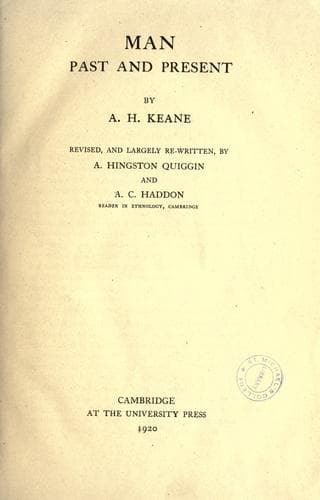
Man, Past and PresentKeane, A. H. (Augustus Henry)
History
Man, Past and Present
Keane, A. H. (Augustus Henry)
Anthropology; Ethnology
#Temperament.# _Somewhat sluggish, with little initiative, but great
endurance; cunning rather than intelligent; generally thrifty and
industrious, but mostly indolent in Siam and Burma; moral standard low,
with slight sense of right and wrong._
#Speech.# _Mainly isolating and monosyllabic, due to phonetic decay;
loss of formative elements compensated by tone; some (south Chinese,
Annamese) highly tonic, but others (in Himalayas and North Burma) highly
agglutinating and consequently toneless._
#Religion.# _Ancestry and spirit-worship, underlying various kinds of
Buddhism; religious sentiment weak in Annam, strong in Tibet; thinly
diffused in China._
#Culture.# _Ranges from sheer savagery (Indo-Chinese aborigines) to a
low phase of civilisation; some mechanical arts (ceramics, metallurgy,
weaving), and agriculture well developed; painting, sculpture, and
architecture mostly in the barbaric stage; letters widespread, but true
literature and science slightly developed; stagnation very general._
Main Divisions.
#Bod-pa.# _Tibetan; Tangut; Horsok; Si-fan; Balti; Ladakhi; Gurkha;
Bhotiya; Miri; Mishmi; Abor._
#Burmese.# _Naga; Kuki-Lushai; Chin; Kakhyen; Manipuri; Karen; Talaing;
Arakanese; Burmese proper._
#Tai-Shan.# _Ahom; Khamti; Ngiou; Lao; Siamese._
#Giao-Shi.# _Annamese; Cochin-Chinese._
#Chinese.# _Chinese proper; Hakka; Hok-lo; Pun-ti._
* * * * *
The Mongolian stock may be divided into two main branches[375]: the
_Mongolo-Tatar_, of the western area, and the _Tibeto-Indo-Chinese_ of
the eastern area, the latter extending into a secondary branch, _Oceanic
Mongols_. These two, that is, the main and secondary branch, which
jointly occupy the greater part of south-east Asia with most of
Malaysia, Madagascar, the Philippines and Formosa, will form the subject
of the present and following chapters. Allowing for encroachments and
overlappings, especially in Manchuria and North Tibet, the northern
"divide" towards the Mongolo-Tatar domain is roughly indicated by the
Great Wall and the Kuen-lun range westwards to the Hindu-Kush, and
towards the south-west by the Himalayas from the Hindu-Kush eastwards to
Assam. The Continental section thus comprises the whole of China proper
and Indo-China, together with a great part of Tibet with Little Tibet
(Baltistan and Ladakh), and the Himalayan uplands including their
southern slopes. This section is again separated from the Oceanic
section by the Isthmus of Kra--the Malay Peninsula belonging ethnically
to the insular Malay world. "I believe," writes Warington Smyth, "that
the Malay never really extended further south than the Kra
isthmus[376]."
Public-domain text, read in full here on John Shaqi.
Reviews
Reviews
No reviews yet
Be the first to share your thoughts on this work.
Elsewhere in the archive
Join the Discussion
Join the discussion
Sign in to leave a comment or review.
Sign InorCreate an account