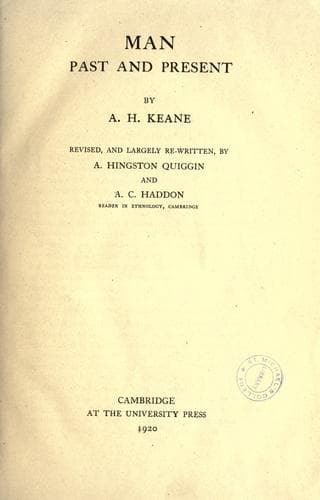
Man, Past and PresentKeane, A. H. (Augustus Henry)
History
Man, Past and Present
Keane, A. H. (Augustus Henry)
Anthropology; Ethnology
From all these considerations it is inferred that the Balti are the
direct descendants of the Sacae, who invaded India about 90 B.C., not
from the west (the Kabul valley) as generally stated, but from the north
over the Karakorum Passes leading directly to Baltistan[382]. Thus lives
again a name renowned in antiquity, and another of those links is
established between the past and the present, which it is the province
of the historical ethnologist to rescue from oblivion.
In Tibet proper the ethnical relations have been confused by the loose
way tribal and even national names are referred to by Prjevalsky and
some other modern explorers. It should therefore be explained that three
somewhat distinct branches of the race have to be carefully
distinguished: 1. The _Bod-pa_[383], "Bodmen," the settled and more or
less civilised section, who occupy most of the southern and more fertile
provinces of which Lhasa is the capital, who till the land, live in
towns, and have passed from the tribal to the civic state. 2. The
_Dru-pa_[384], peaceful though semi-nomadic pastoral tribes, who live in
tents on the northern plateaux, over 15,000 feet above sea-level. 3. The
_Tanguts_[385], restless, predatory tribes, who hover about the
north-eastern borderland between Koko-nor and Kansu.
All these are true Tibetans, speak the Tibetan language, and profess one
or other of the two national religions, _Bonbo_ and Lamaism (the Tibetan
form of Buddhism). But the original type is best preserved, not amongst
the cultured Bod-pa, who in many places betray a considerable admixture
both of Chinese and Hindu elements, but amongst the Dru-pa, who on their
bleak upland steppes have for ages had little contact with the
surrounding Mongolo-Turki populations. They are described by W. W.
Rockhill from personal observation as about five feet five inches high,
and round-headed, with wavy hair, clear-brown and even hazel eye,
cheek-bone less high than the Mongol, thick nose, depressed at the root,
but also prominent and even aquiline and narrow but with broad nostrils,
large-lobed ears standing out to a less degree than the Mongol, broad
mouth, long black hair, thin beard, generally hairless body, broad
shoulders, very small calves, large foot, coarse hand, skin coarse and
greasy and of light brown colour, though "frequently nearly white, but
when exposed to the weather a dark brown, nearly the colour of our
American Indians. Rosy cheeks are quite common amongst the younger
women[386]."
Public-domain text, read in full here on John Shaqi.
Reviews
Reviews
No reviews yet
Be the first to share your thoughts on this work.
Elsewhere in the archive
Join the Discussion
Join the discussion
Sign in to leave a comment or review.
Sign InorCreate an account