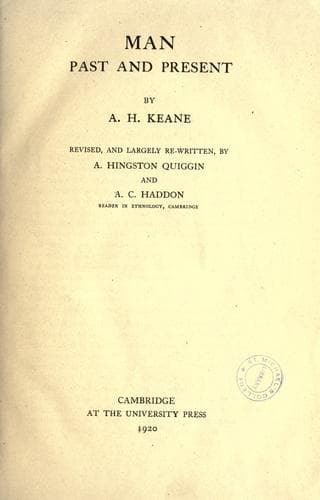
Man, Past and PresentKeane, A. H. (Augustus Henry)
History
Man, Past and Present
Keane, A. H. (Augustus Henry)
Anthropology; Ethnology
This observer quotes Bishop Bigandet, a forty years' resident amongst
the natives, to the effect that "in Burmah and Siam the doctrines of
Buddhism have produced a striking, and to the lover of true civilization
a most interesting result--the almost complete equality of the condition
of the women with that of the men. In these countries women are seen
circulating freely in the streets; they preside at the _comptoir_, and
hold an almost exclusive possession of the bazaars. Their social
position is more elevated, in every respect, than in the regions where
Buddhism is not the predominating creed. They may be said to be men's
companions, and not their slaves."
Burma is one of those regions where tattooing has acquired the rank of a
fine art. Indeed the intricate designs and general pictorial effect
produced by the Burmese artists on the living body are rivalled only by
those of Japan, New Zealand, and some other Polynesian groups. Hallett,
who states that "the Burmese, the Shans, and certain Burmanized tribes
are the only peoples in the south of Asia who are known to tattoo their
body," tells us that the elaborate operation is performed only on the
male sex, the whole person from waist to knees, and amongst some Shan
tribes from neck to foot, being covered with heraldic figures of
animals, with intervening traceries, so that at a little distance the
effect is that of a pair of dark-blue breeches[435]. The pigments are
lamp-black or vermilion, and the pattern is usually first traced with a
fine hair pencil and then worked in by a series of punctures made by a
long pointed brass style[436].
Public-domain text, read in full here on John Shaqi.
Reviews
Reviews
No reviews yet
Be the first to share your thoughts on this work.
Elsewhere in the archive
Join the Discussion
Join the discussion
Sign in to leave a comment or review.
Sign InorCreate an account