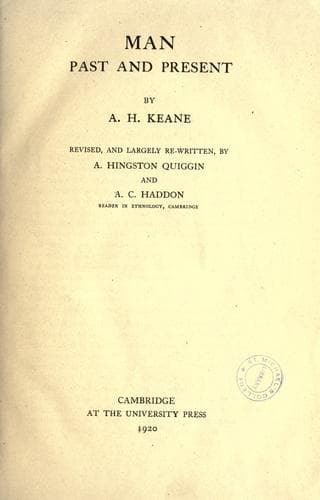
Man, Past and PresentKeane, A. H. (Augustus Henry)
History
Man, Past and Present
Keane, A. H. (Augustus Henry)
Anthropology; Ethnology
"The Mans-Tien, the Mans-Coc, the Mans-Meo (Miao, Miao-tse, or Mieu)
present a pretty complete identity with the Pan-y and the Pan-yao of
South Kwang-si; they are the debris of a very ancient race, which with
T. de Lacouperie may be called pre-Chinese. This early race, which bore
the name of _Pan-hu_ or _Ngao_, occupied Central China before the
arrival of the Chinese. According to M. d'Hervey de Saint-Denys, the
mountains and valleys of Kwei-chau where these Miao-tse still survive
were the cradle of the Pan-hu. In any case it seems certain that the
T'hai and the Man race came from Central Asia, and that, from the
anthropological standpoint, they differ altogether from the Mongol group
represented by the Chinese and the Annamese. The Man especially presents
striking affinities with the Aryan type."
Thus is again confirmed by the latest investigations, and by the
conclusions of some of the leading members of the French school of
anthropology, the view first advanced by me in 1879, that peoples of the
Caucasic (here called "Aryan") division had already spread to the utmost
confines of south-east Asia in remote prehistoric times, and had in
this region even preceded the first waves of Mongolic migration
radiating from their cradle-land on the Tibetan plateau[459].
Reference was above made to the singular lack of political cohesion at
all times betrayed by the Tai-Shan peoples. The only noteworthy
exception is the Siamese branch, which forms the bulk of the population
in the Menam basin. In this highly favoured region of vast
hill-encircled alluvial plains of inexhaustible fertility, traversed by
numerous streams navigable for light craft, and giving direct access to
the inland waters of Malaysia, the Southern Shans were able at an early
date to merge the primitive tribal groups in a great nationality, and
found a powerful empire, which at one time dominated most of Indo-China
and the Malay Peninsula.
Siam, alone of all the Shan states, even still maintains a precarious
independence, although now again reduced by European aggression to
little more than the natural limits of the fluvial valley, which is
usually regarded by the Southern Shans as the home of their race. Yet
they appear to have been here preceded by the Caucasic Khmers
(Cambojans), whose advent is referred in the national chronicles to the
year 543 B.C. and who, according to the Hindu records, were expelled
about 443 A.D. It was through these Khmers, and not directly from India,
that the "Sayamas" received their Hindu culture, and the Siamese annals,
mingling fact with fiction, refer to the miraculous birth of the
national hero, Phra-Ruang, who threw off the foreign yoke, declared the
people henceforth T'hai, "Freemen," invented the present Siamese
alphabet, and ordered the Khom (Cambojan) to be reserved in future for
copying the sacred writings.
Public-domain text, read in full here on John Shaqi.
Reviews
Reviews
No reviews yet
Be the first to share your thoughts on this work.
Elsewhere in the archive
Join the Discussion
Join the discussion
Sign in to leave a comment or review.
Sign InorCreate an account