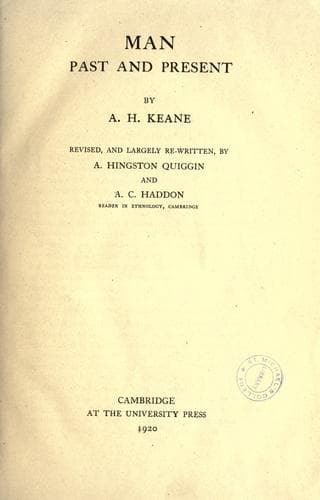
Man, Past and PresentKeane, A. H. (Augustus Henry)
History
Man, Past and Present
Keane, A. H. (Augustus Henry)
Anthropology; Ethnology
[383] W. W. Rockhill, our best living authority, accepts none of the
current explanations of the widely diffused term _bod_ (_bhot, bhot_),
which appears to form the second element in the word _Tibet_
(_Stod-Bod_, pronounced _Teu-Beu_, "Upper Bod," _i.e._ the central and
western parts in contradistinction to _Maen-Bod_, "Lower Bod," the
eastern provinces). _Notes on the Ethnology of Tibet_, Washington, 1895,
p. 669. This writer finds the first mention of Tibet in the form
_Tobbat_ (there are many variants) in the Arab Istakhri's works, about
590 A.H., while T. de Lacouperie would connect it with the Tatar kingdom
of _Tu-bat_ (397-475 A.D.). This name might easily have been extended by
the Chinese from the Tatars of Kansu to the neighbouring Tanguts, and
thus to all Tibetans.
[384] _Hbrog-pa_, _Drok-pa_, pronounced _Dru-pa_.
[385] The Mongols apply the name _Tangut_ to Tibet and call all Tibetans
_Tangutu_, "which should be discarded as useless and misleading, as the
people inhabiting this section of the country are pure Tibetans"
(Rockhill, p. 670). It is curious to note that the Mongol Tangutu is
balanced by the Tibetan _Sok-pa_, often applied to all Mongolians.
[386] _Notes on the Ethnology of Tibet_, 1895, p. 675; see also S.
Chandra Das, _Journey to Lhasa and Central Tibet_, 1904; F. Grenard,
_Tibet: the Country and its Inhabitants_, 1904; G. Sandberg, _Tibet and
the Tibetans_, 1906; and L. A. Waddell, _Lhasa and its Mysteries, with a
record of the Expedition of 1903-1904_, 1905.
[387] _Isvestia_, XXI. 3.
[388] _Ethnology_, p. 305.
[389] _Abor_, _i.e._ "independent," is the name applied by the Assamese
to the East Himalayan hill tribes, the _Minyong_, _Padam_ and _Hrasso_,
who are the _Slo_ of the Tibetans. These are all affiliated by Desgodins
to the Lho-pa of Bhutan (_Bul. Soc. Geogr._, October, 1877, p. 431), and
are to be distinguished from the _Bori_ (_i.e._ "dependent") tribes of
the plains, all more or less Hinduized Bhotiyas (Dalton, _Ethnology of
Bengal_, p. 22 sq.). See A. Hamilton, _In Abor Jungles_, 1912.
[390] Not to be confused with the _Khas_, as the wild tribes of the Lao
country (Siam) are collectively called. Capt. Eden Vansittart thinks in
Nepal the term is an abbreviation of Kshatriya, or else means "fallen."
This authority tells us that, although the Khas are true Gurkhas, it is
not the Khas who enlist in our Gurkha regiments, but chiefly the Magars
and Gurungs, who are of purer Bhotiya race and less completely Hinduized
("The Tribes, Clans, and Castes of Nepal," in _Journ. As. Soc. Bengal_;
LXIII. I, No. 4).
[391] _Embassy to the Court of the Teshoo Lama_, p. 350 sq.
[392] "Voila, je crois, le vrai Tibetain des pays cultives du sud, qui
se regarde comme bien plus civilise que les pasteurs ou bergers du nord"
(_Le Thibet_, p. 253).
Public-domain text, read in full here on John Shaqi.
Reviews
Reviews
No reviews yet
Be the first to share your thoughts on this work.
Elsewhere in the archive
Join the Discussion
Join the discussion
Sign in to leave a comment or review.
Sign InorCreate an account