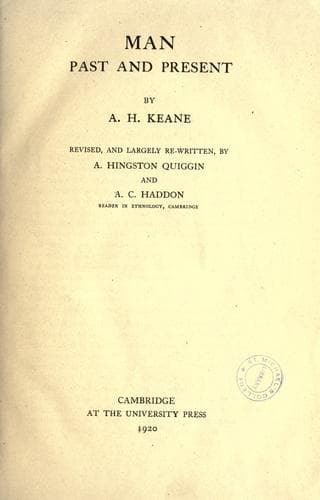
Man, Past and PresentKeane, A. H. (Augustus Henry)
History
Man, Past and Present
Keane, A. H. (Augustus Henry)
Anthropology; Ethnology
Hose and Haddon have introduced the term _Klemantan_ (_Kalamantan_) for
the weak agricultural tribes such as the _Murut_, _Kalabit_, _Land
Dayak_, _Sebop_, _Barawan_, _Milanau_, etc.[519] Brook Low[520], who
knew the Land Dayak well, gives a very favourable account of the people
and this opinion has been confirmed by other travellers. They are
described as amiable, honest, grateful, moral and hospitable. Crimes of
violence, other than head-hunting, are unknown. The circular _panga_ is
a "house set apart for the residence of young unmarried men, in which
the trophy-heads are kept, and here also all ceremonial receptions take
place[521]." The _baloi_ of the Ot Danom of the Kahajan river is very
similar[522]. The very energetic and dominating _Bahau-Kenyah-Kayan_
group are rather short in stature, with slightly broad heads. They
occupy the best tracts of land which lie in the undulating hills at the
upper reaches of the rivers, between the swampy low country and the
mountains. The Kayan more especially have almost exterminated some of
the smaller tribes. The Klemantan and Kenyah-Kayan tribes are
agriculturalists. They clear the jungle off the low hills that flank the
tributaries of the larger rivers, but always leave a few scattered trees
standing; irrigation is attempted by the Kalabits only, as _padi_ rice
is grown like any other cereals on dry ground; swamp _padi_ is also
grown on the low land. In their gardens they grow yams, pumpkins, sugar
cane, bananas, and sometimes coconuts and other produce. They hunt all
land animals that serve as food, and fish, usually with nets, in the
rivers, or spear those fish that have been stupefied with _tuba_; river
prawns are also a favourite article of diet.
They all live in long communal houses which are situated on the banks of
the rivers. Among the Klemantan tribes the headman has not much
influence, unless he is a man of exceptional power and energy, but among
the larger tribes and especially among the Kayan and Kenyah the headmen
are the real chiefs and exercise undisputed sway. The Kenyah are perhaps
the most advanced in social evolution, holding their own by superior
solidarity and intelligence against the turbulent Kayan.
All the agricultural tribes are artistic, but in varying degrees; they
are also musical and sing delightful chorus songs. In some tribes the
ends of the beams of the houses are carved to represent various animals,
in some the verandah is decorated with boldly carved planks, or with
painted boards and doors. The bamboo receptacles carved in low relief,
the bone handles of their swords and the minor articles of daily life,
are decorated in a way that reveals the true artistic spirit. Both
Kenyah and Kayan smelt iron and make spear heads and sword blades, the
former being especially noted for their good steel. The forge with two
bellows is the form widely spread in Malaysia.
Public-domain text, read in full here on John Shaqi.
Reviews
Reviews
No reviews yet
Be the first to share your thoughts on this work.
Elsewhere in the archive
Join the Discussion
Join the discussion
Sign in to leave a comment or review.
Sign InorCreate an account