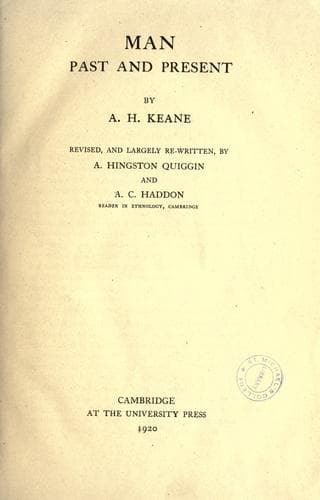
Man, Past and PresentKeane, A. H. (Augustus Henry)
History
Man, Past and Present
Keane, A. H. (Augustus Henry)
Anthropology; Ethnology
The Kenyah-Kayan migration was that of a people of a slightly higher
grade of culture. They were agriculturalists, but the social
organisation was firmer and they were probably superior in physique. If
they introduced iron weapons, this would give them an enormous
advantage. These immigrant agricultural artisans, directed by powerful
chiefs, had no difficulty in taking possession of the most desirable
land.
From an opposite point of the compass in early times came another
agricultural people who strangely enough have strong individualistic
tendencies, the usually peaceable habits of tillers of the soil having
been complicated by a lust for heads and other warlike propensities. But
the Iban do not appear to have gained much against the Kenyah and Kayan.
Conquest implies a strong leader, obedience to authority and concerted
action. The Iban appear to be formidable only when led and organised by
Europeans.
The Malay was of a yet higher social type. His political organisation
was well established, and he had the advantage of religious enthusiasm,
for Islam has no small share in the expansion of the Malay. He is a
trader, and still more an exploiter, having a sporting element in his
character not altogether compatible with steady trade. Then appeared on
the scene the Anglo-Saxon overlord. The quality of firmness combined
with justice made itself felt. At times the lower social types hurled
themselves, but in vain, against the instrument that had been forged and
tempered in a similar turmoil of Iberian, Celt, Angle and Viking in
Northern Europe. Now they acknowledge that safety of life and property
and almost complete liberty are fully worth the very small price that
they have to pay for them[524].
The cult of omen animals, most frequently birds, is indigenous to
Borneo. These are possessed with the spirit of certain invisible beings
above, and bear their names, and are invoked to secure good crops,
freedom from accident, victory in war, profit in exchange, skill in
discourse and cleverness in all native craft. The Iban have a belief in
_Ngarong_ or spirit-helpers, somewhat resembling that of the _Manitu_ of
North America. The _Ngarong_ is the spirit of a dead relative who visits
a dreamer, who afterwards searches for the outward and visible sign of
his spiritual protector, and finds it in some form, perhaps a natural
object, or some one animal, henceforth held in special respect[525].
Public-domain text, read in full here on John Shaqi.
Reviews
Reviews
No reviews yet
Be the first to share your thoughts on this work.
Elsewhere in the archive
Join the Discussion
Join the discussion
Sign in to leave a comment or review.
Sign InorCreate an account