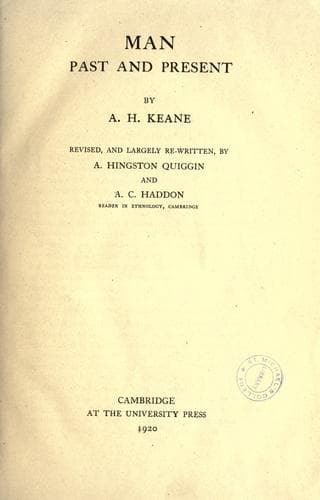
Man, Past and PresentKeane, A. H. (Augustus Henry)
History
Man, Past and Present
Keane, A. H. (Augustus Henry)
Anthropology; Ethnology
"Shamanism amongst the Siberian peoples," concludes our Russian
authority, "is at the present time in a moribund condition; it must die
out with those beliefs among which alone such phenomena can arise and
flourish. Buddhism on the one hand, and Muhammadanism on the other, not
to mention Christianity, are rapidly destroying the old ideas of the
tribes among whom the shamans performed. Especially has the more ancient
Black Faith suffered from the Yellow Faith preached by the lamas. But
the shamans, with their dark mysterious rites, have made a good struggle
for life, and are still frequently found among the native Christians and
Muhammadans. The mullahs and lamas have even been obliged to become
shamans to a great extent, and many Siberian tribes, who are nominally
Christians, believe in shamans, and have recourse to them."
Of all members of the Tungusic family the Manchus alone can be called a
historical people. If they were really descended from the _Khitans_ of
the Sungari valley, then their authentic records will date from the
tenth century A.D., when these renowned warriors, after overthrowing the
Pu-hai (925), founded the Liao dynasty and reduced a great part of North
China and surrounding lands. The Khitans, from whom China was known to
Marco Polo as _Khitai_ (Cathay), as it still is to the Russians, were
conquered in 1125 by the _Niu-chi_ (_Yu-chi, Nu-chin_) of the Shan-alin
uplands, reputed cradle of the Manchu race. These Niu-chi, direct
ancestors of the Manchus, founded (1115) the State known as that of the
"Golden Tartars," from _Kin_, "gold," the title adopted by their chief
Aguta, "because iron (in reference to the _Liao_, 'Iron' dynasty) may
rust, but gold remains ever pure and bright." The Kins, however,
retained their brightness only a little over a century, having been
eclipsed by Jenghiz-Khan in 1234. But about the middle of the fourteenth
century the Niu-chi again rose to power under Aishiu-Gioro, who,
although of miraculous birth and surrounded by other legendary matter,
appears to have been a historical person. He may be regarded as the true
founder of the Manchu dynasty, for it was in his time that this name
came into general use. Sing-tsu, one of his descendants, constructed the
palisade, a feeble imitation of the Great Wall, sections of which still
exist. Thai-tsu, a still more famous member of the family, greatly
extended the Manchu Kingdom (1580-1626), and it was his son Tai-dsung
who first assumed the imperial dignity under the title of Tai-Tsing.
After his death, the Ming dynasty having been overthrown by a rebel
chief, the Manchus were invited by the imperialists to aid in restoring
order, entered Peking in triumph, and, finding that the last of the
Mings had committed suicide, placed Tai-dsung's nephew on the throne,
thus founding the Manchu dynasty (1644) which lasted down to 1912.
Public-domain text, read in full here on John Shaqi.
Reviews
Reviews
No reviews yet
Be the first to share your thoughts on this work.
Elsewhere in the archive
Join the Discussion
Join the discussion
Sign in to leave a comment or review.
Sign InorCreate an account