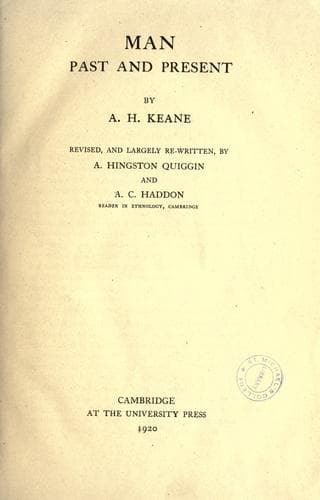
Man, Past and PresentKeane, A. H. (Augustus Henry)
History
Man, Past and Present
Keane, A. H. (Augustus Henry)
Anthropology; Ethnology
Closely related to the Manchus (of the same stock says Sir H. H.
Howorth, the distinction being purely political) are the _Dauri_, who
give their name to the extensive Daur plateau, and formerly occupied
both sides of the Upper Amur. Daur is, in fact, the name applied by the
Buryats to all the Tungus peoples of the Amur basin. The Dauri proper,
who are now perhaps the best representatives of the original Manchu
type, would seem to have intermingled at a remote time with the
long-headed pre-Mongol populations of Central Asia. They are "taller and
stronger than the Oronchons [Tungus groups lower down the Amur]; the
countenance is oval and more intellectual, and the cheeks are less
broad. The nose is rather prominent, and the eyebrows straight. The skin
is tawny, and the hair brown[628]." Most of these characters are such as
we should expect to find in a people of mixed Mongolo-Caucasic descent,
the latter element being derived from the long-headed race who had
already reached the present Mongolia, Manchuria, Korea, and the adjacent
islands during neolithic times. Thus may be explained the tall stature,
somewhat regular features, brown hair, light eyes, and even florid
complexion so often observed amongst the present inhabitants of
Manchuria, Korea, and parts of North China.
But no admixture, except of Chinese literary terms, is seen in the
Manchu language, which, like Mongolic, is a typical member of the
agglutinating Ural-Altaic family. Despite great differences, lexical,
phonetic, and even structural, all the members of this widespread order
of speech have in common a number of fundamental features, which justify
the assumption that all spring from an original stock language, which
has long been extinct, and the germs of which were perhaps first
developed on the Tibetan plateau. The essential characters of the system
are:--(1) a "root" or notional term, generally a closed syllable,
nominal or verbal, with a vowel or diphthong, strong or weak (hard or
soft) according to the meaning of the term, hence incapable of change;
(2) a number of particles or relational terms somewhat loosely postfixed
to the root, but incorporated with it by the principle of (3) vowel
harmony, a kind of vocal concordance, in virtue of which the vowels of
all the postfixes must harmonise with the unchangeable vowel of the
root. If this is strong all the following vowels of the combination, no
matter what its length, must be strong; if weak they must conform in the
same way. With nominal roots the postfixes are necessarily limited to
the expression of a few simple relations; but with verbal roots they are
in principle unlimited, so that the multifarious relations of the verb
to its subject and object are all incorporated in the verbal compound
itself, which may thus run at times to inordinate lengths. Hence we have
the expression "incorporating," commonly applied to this agglutinating
system, which sometimes goes so far as to embody the notions of
Public-domain text, read in full here on John Shaqi.
Reviews
Reviews
No reviews yet
Be the first to share your thoughts on this work.
Elsewhere in the archive
Join the Discussion
Join the discussion
Sign in to leave a comment or review.
Sign InorCreate an account