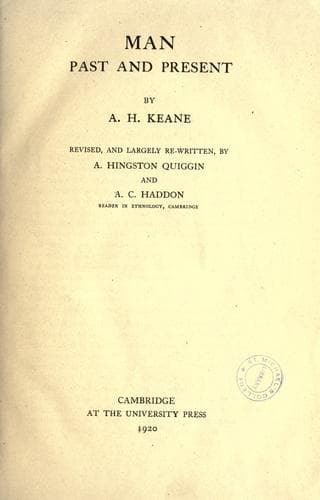
Man, Past and PresentKeane, A. H. (Augustus Henry)
History
Man, Past and Present
Keane, A. H. (Augustus Henry)
Anthropology; Ethnology
"The doomed one," writes Harry de Windt, "takes a lively interest in the
proceedings, and often assists in the preparation for his own death. The
execution is always preceded by a feast, where seal and walrus meat are
greedily devoured, and whisky consumed till all are intoxicated. A
spontaneous burst of singing and the muffled roll of walrus-hide drums
then herald the fatal moment. At a given signal a ring is formed by the
relations and friends, the entire settlement looking on from the
background. The executioner (usually the victim's son or brother) then
steps forward, and placing his right foot behind the back of the
condemned, slowly strangles him to death with a walrus-thong. A kamitok
took place during the latter part of our stay[640]."
This custom of "voluntary death" is sometimes due to sorrow at the death
of a near relative, a quarrel at home, or merely weariness of life, and
Bogoras thinks that the custom of killing old people does not exist as
such, but is voluntarily chosen in preference to the hard life of an
invalid[641].
Most recent observers have come to look upon the Chukchi and _Koryaks_
as essentially one and the same people, the chief difference being that
the latter are if possible even more degraded than their northern
neighbours[642]. Like them they are classed as sedentary fisherfolk or
nomad reindeer-owners, the latter, who call themselves Tumugulu,
"Wanderers," roaming chiefly between Ghiyiginsk Bay and the Anadyr
river. Through them the Chukchi merge gradually in the _Itelmes_, who
are better known as Kamchadales, from the Kamchatka river, where they
are now chiefly concentrated. Most of the Itelmes are already Russified
in speech and--outwardly at least--in religion; but they still secretly
immolate a dog now and then, to propitiate the malevolent beings who
throw obstacles in the way of their hunting and fishing expeditions. Yet
their very existence depends on their canine associates, who are of a
stout, almost wolfish breed, inured to hunger and hardships, and
excellent for sledge work.
Somewhat distinct both from all these Hyperboreans and from their
neighbours, the Orochons, Golds, Manegrs and other Tungus peoples, are
the _Gilyaks_, formerly widespread, but now confined to the Amur delta
and the northern parts of Sakhalin[643]. Some observers have connected
them with the Ainu and the Korean aborigines, while A. Anuchin detects
two types--a Mongoloid with sparse beard, high cheek-bones, and flat
face, and a Caucasic with bushy beard and more regular features[644].
The latter traits have been attributed to Russian mixture, but, as
conjectured by H. von Siebold, are more probably due to a fundamental
connection with their Ainu neighbours[645].
Public-domain text, read in full here on John Shaqi.
Reviews
Reviews
No reviews yet
Be the first to share your thoughts on this work.
Elsewhere in the archive
Join the Discussion
Join the discussion
Sign in to leave a comment or review.
Sign InorCreate an account